
Some links in this guide are affiliate links. If you buy through them, we earn a small commission at no extra cost to you. We only recommend gear we’d actually fish with.
Quick Reference 2026 Picks
Guide last updated: August 2, 2026
Buying your first fishing kayak is supposed to be exciting. Instead it turns into a homework project. The price range runs from $200 to $3,000, specs overlap in ways that don’t mean much until you’re on the water, and reviews contradict each other depending on which site you’re reading. Meanwhile the kayak aisle at Walmart has three options and Bass Pro has thirty, and none of them are labeled in a way that tells you what actually matters for fishing.
Here’s the short version: for fishing Oklahoma’s lakes, ponds, and slow rivers, the decision comes down to a few real factors — beam width for stability, hull design, and how much you want to spend without buying twice. This guide covers seven kayaks across the $275–$1,100 range that represent the honest spectrum of what beginners should consider. Stability, fishing-specific features, and value. That’s the criteria.
Best beginner fishing kayaks at a glance
| Kayak | Type | Length | Width | Approx. Price | Best For |
|---|---|---|---|---|---|
| Lifetime Tamarack Angler 100 | Sit-on-top | 10’0″ | 31″ | ~$275 | True budget entry, first-season testing |
| Pelican Sentinel 100X Angler | Sit-on-top | 9’6″ | 30″ | ~$440 | Lightest pick — easiest to car-top solo |
| Pelican Catch Classic Angler | Sit-on-top | 10’0″ | 34″ | ~$510 | Widest hull, best $400–$600 step-up |
| Pelican Catch Mode 110 | Sit-on-top | 11’0″ | 33.5″ | ~$800 | Best features-per-dollar under $800 |
| Perception Outlaw 11.5 | Sit-on-top | 11’6″ | 33.5″ | ~$849 | Bigger anglers, max stability priority |
| Old Town Sportsman 106 | Sit-on-top | 10’6″ | 31.5″ | ~$899 | Best all-around build quality and fit |
| Old Town Sportsman BigWater 132 | Sit-on-top | 13’2″ | 34″ | See Amazon | Big water fishing, long-haul investment |
Prices are approximate MSRP and may vary by retailer and season. Always verify current pricing before purchasing. Some kayaks do not include a paddle — noted in each review below.
1. Lifetime Tamarack Angler 100 — Best Budget Pick

10’0″ · 31″ wide · ~52 lbs · 275 lb capacity · ~$275 at Walmart · Paddle included
The Lifetime Tamarack Angler 100 is the “Walmart yak” that gets more beginner anglers on the water than any other kayak on this list — possibly more than all of them combined. It’s not the nicest kayak. The plastic is basic, the seat is a simple adjustable pad, and at 31 inches wide it sits at the lower edge of what we’d call confidently stable. But it floats, it fishes, it comes with a paddle, and it costs less than a good rod and reel combo. For someone who wants to try kayak fishing before committing real money, this is an honest answer.
Two flush-mounted rod holders, a small bow storage compartment, and a recessed water bottle holder are the fishing features — nothing fancy, nothing that gets in the way. Oklahoma pond fishing, quiet coves on Thunderbird or Hefner, early morning bass along a protected shoreline — the Tamarack handles that just fine. Where it struggles is in wind and chop; at its width and length, you’ll feel every gust. That’s not a dealbreaker on calm Oklahoma mornings, but it is a limitation to know going in.
Best for: Anglers who want to get on the water before committing to a serious purchase, or anyone who found one on Facebook Marketplace for $150 and wants to know if it’s worth rigging up. It absolutely is. One note: the 275 lb weight capacity is the tightest on this list — larger anglers should not exceed 70% of rated capacity for safe performance.
- Lowest price — paddle included
- Available at Walmart, buy same day
- Risk-free way to test the sport
- 275 lb capacity — tightest on this list
- 31″ beam feels tippy in open-water wind
2. Pelican Sentinel 100X Angler — Lightest Pick for Smaller Paddlers
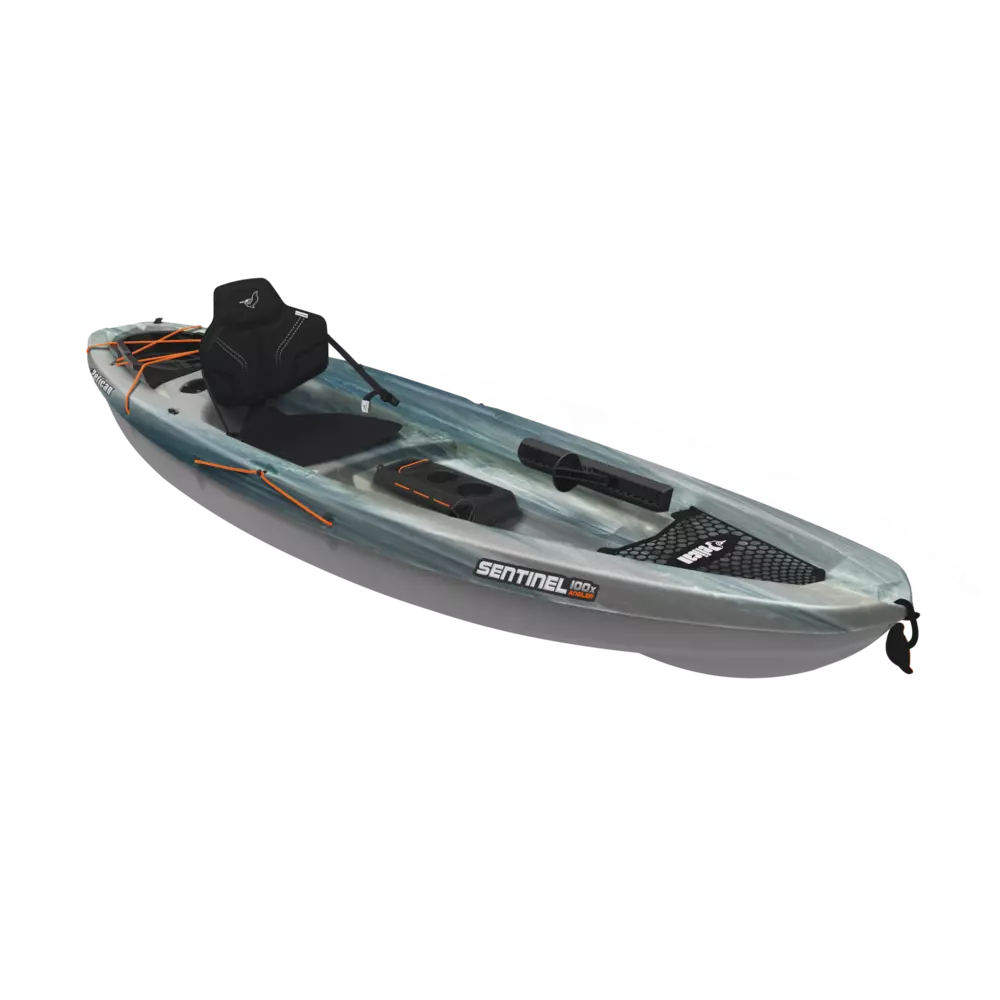
9’6″ · 30″ wide · 44 lbs · 275 lb capacity · ~$440 · Check current availability
If car-topping a 65–75 lb kayak solo is a dealbreaker — or you’re a smaller-framed angler who wants a kayak that moves with you rather than against you — the Pelican Sentinel 100X Angler answers that problem directly. At just 44 lbs it’s the lightest hard-shell fishing kayak on this list by a significant margin. You can load it without a second person and still fish four rod holders and a proper adjustable seat. That’s not a compromise pick — that’s a genuinely useful piece of gear designed for people the heavier kayaks aren’t built for.
Pelican’s ExoPak system gives you 2 flush-mounted rod holders plus 2 vertical holders in a removable rear storage compartment — four total, which beats several kayaks that cost twice as much. The adjustable ErgoLounge seat is comfortable for all-day outings, there’s a center console for tackle storage, and the 9’6″ hull is easy to maneuver in tight coves and creek arms where bigger kayaks struggle.
Best for: Smaller or lighter-framed anglers, anyone who car-tops solo, and beginners who want a genuinely manageable first kayak that’s still rigged for serious fishing. Larger anglers (200 lbs+) should look at the wider picks below — the 30″ beam and 275 lb capacity are the main trade-offs for the weight savings.
Note: availability on Amazon can be seasonal — check current stock or visit pelicansport.com if temporarily out of stock.
- Lightest on this list at just 44 lbs
- 4 rod holders including ExoPak system
- Easiest to car-top and handle solo
- Narrowest beam (30″) — less stable than wider picks
- 275 lb capacity limits larger anglers
3. Pelican Catch Classic Angler — Best Step-Up Under $600
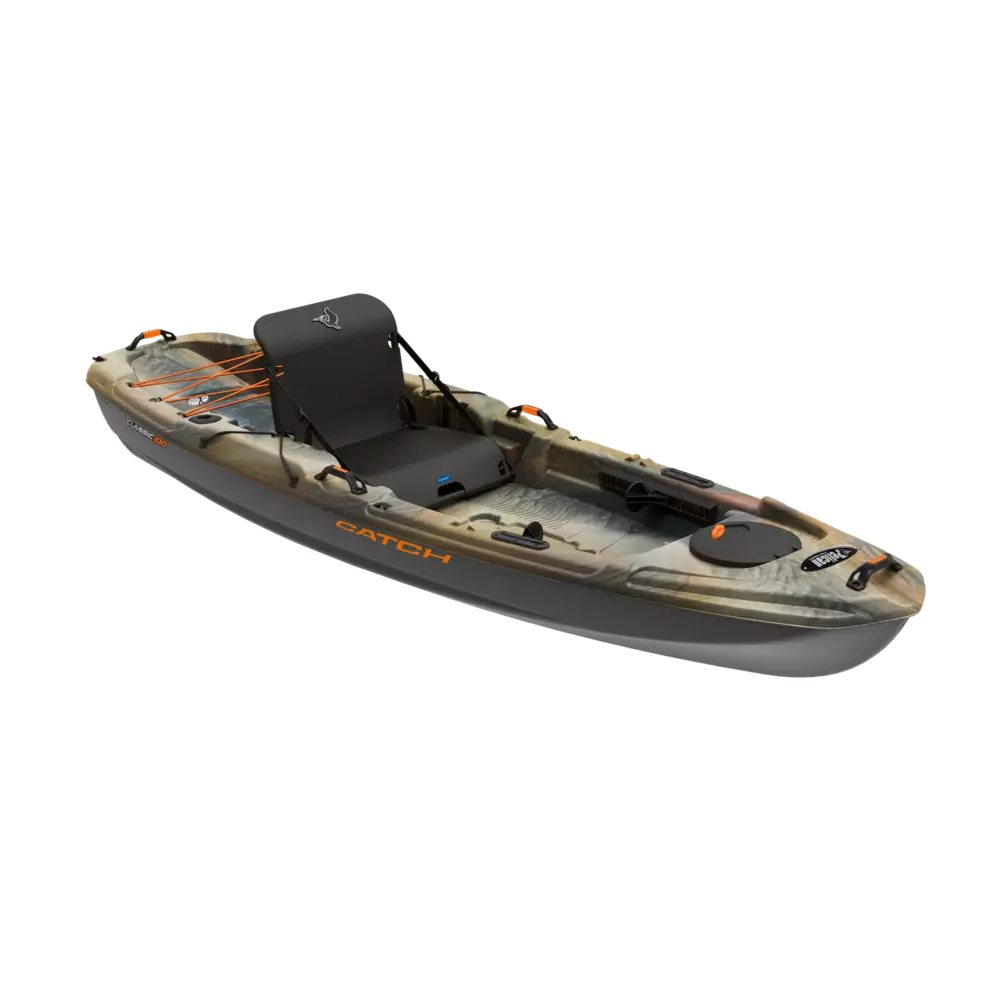
10’0″ · 34″ wide · ~57 lbs · 350 lb capacity · ~$510 · Check for paddle inclusion by color/model
The Pelican Catch Classic Angler fills the gap between the $275 Tamarack and the $800 Catch Mode with something meaningfully better than a price bump. At 34 inches wide it’s the widest hull on this entire list — wider even than the Catch Mode 110 — and Pelican’s tunnel hull design delivers the kind of primary stability that lets confident beginners eventually fish from a standing position. If the Tamarack felt narrow, this is the answer.
The Ergocast Classic seat adjusts between high and low positions, dual accessory/gear rails run along the gunwales for adding RAM mounts without drilling, and a locking bow hatch secures valuables up front. The 350 lb capacity leaves headroom for most anglers plus a full day’s gear. At around $510 this is a legitimate fishing platform — not a Walmart yak with a rod holder taped on, but a purpose-built kayak designed for the water.
Best for: Anglers stepping up from the Tamarack who want maximum beam width and initial stability before committing to $800+. Also the right pick if you’ve felt nervous on a kayak before — at 34 inches, nothing else on this list is wider.
- Widest beam on this list (34″) — best initial stability
- Dual gear rails and locking bow hatch
- Fills the $400–$600 gap with real fishing features
- Heavier than the Tamarack or Sentinel (~57 lbs)
- Wider hull is slower to paddle than narrower kayaks
4. Pelican Catch Mode 110 — Best Under $800

11’0″ · 33.5″ wide · ~64 lbs · 325 lb capacity · ~$799 · Paddle not included
The Pelican Catch Mode 110 is the kayak that replaced the Catch Classic as the go-to mid-range recommendation in 2025, and for good reason. At 33.5 inches wide it’s significantly more stable than the Tamarack, which makes a real difference on any open water with wind. The Ergoboost seat is a genuine upgrade — you can fish six hours and not feel it in your back the way you would on a basic padded seat. The retractable skeg is the feature most competitors skip at this price point: it dramatically improves tracking in crosswind conditions, which is one of the most frustrating problems for new kayak anglers.
Two side gear track rails are integrated into the hull, which means you can add RAM mounts, rod holders, and accessories without drilling. Four flush-mounted rod holders are already in place. This is a legitimately rigged platform for $800 — designed from the hull up for fishing. The one thing you’ll need to add is a paddle: budget $60–$100 for a decent 230 cm fishing paddle and factor it into your total cost.
Best for: Beginners who want a purpose-built fishing kayak without spending close to a thousand dollars. The stability-to-price ratio here is the best of any kayak on this list. Worth noting: the Catch Mode 110 is widely stocked at Bass Pro Shops and Cabela’s, which means you can try the seat in person before buying.
- Retractable skeg solves crosswind tracking
- Ergoboost seat comfortable for all-day fishing
- Integrated gear tracks — no drilling needed
- Paddle not included — add $60–$100 to budget
- 325 lb capacity is mid-range for this price bracket
5. Perception Outlaw 11.5 — Best for Stability

11’6″ · 33.5″ wide · ~65 lbs · 375 lb capacity · ~$849 · Paddle not included
The Perception Outlaw 11.5 is the kayak for anglers who want to feel planted on the water above everything else — and it delivers. At 33.5 inches wide and 11’6″ long with a high-volume hull, it is one of the most stable sit-on-top fishing kayaks at this price point. The 375 lb weight capacity is the highest on this list, making it the right answer for bigger and taller anglers who found the Tamarack or Sportsman felt narrow. The stadium-style Phase 3 AirPro seat is well-regarded for all-day comfort and adjusts easily on the water without tools.
Three flush-mounted rod holders, adjustable foot braces, and a large rear tank well round out the fishing setup. There are no integrated gear tracks, which means adding accessories requires aftermarket rail mounts or drilling. The hull doesn’t track quite as precisely as the Pelican Catch Mode’s skegged hull, but it makes up for it with a confidence-inspiring flat-bottom feel that new anglers consistently praise. On Reddit, the Outlaw 11.5 shows up frequently in “what did you buy?” posts from anglers who prioritized not tipping over anything else. Good instinct.
Best for: Heavier anglers, anyone who’s felt nervous on a kayak before, and beginners who want maximum stability over tracking efficiency. Also a strong pick if you plan to catfish from an anchored position. Budget at least $80–$100 for a 240–250 cm paddle to match the wider beam.
- Highest weight capacity on this list (375 lbs)
- Most stable primary feel — hardest to tip
- Phase 3 AirPro seat well-rated for all-day fishing
- No integrated gear tracks — accessories require drilling
- Paddle not included
6. Old Town Sportsman 106 — Best All-Around Value
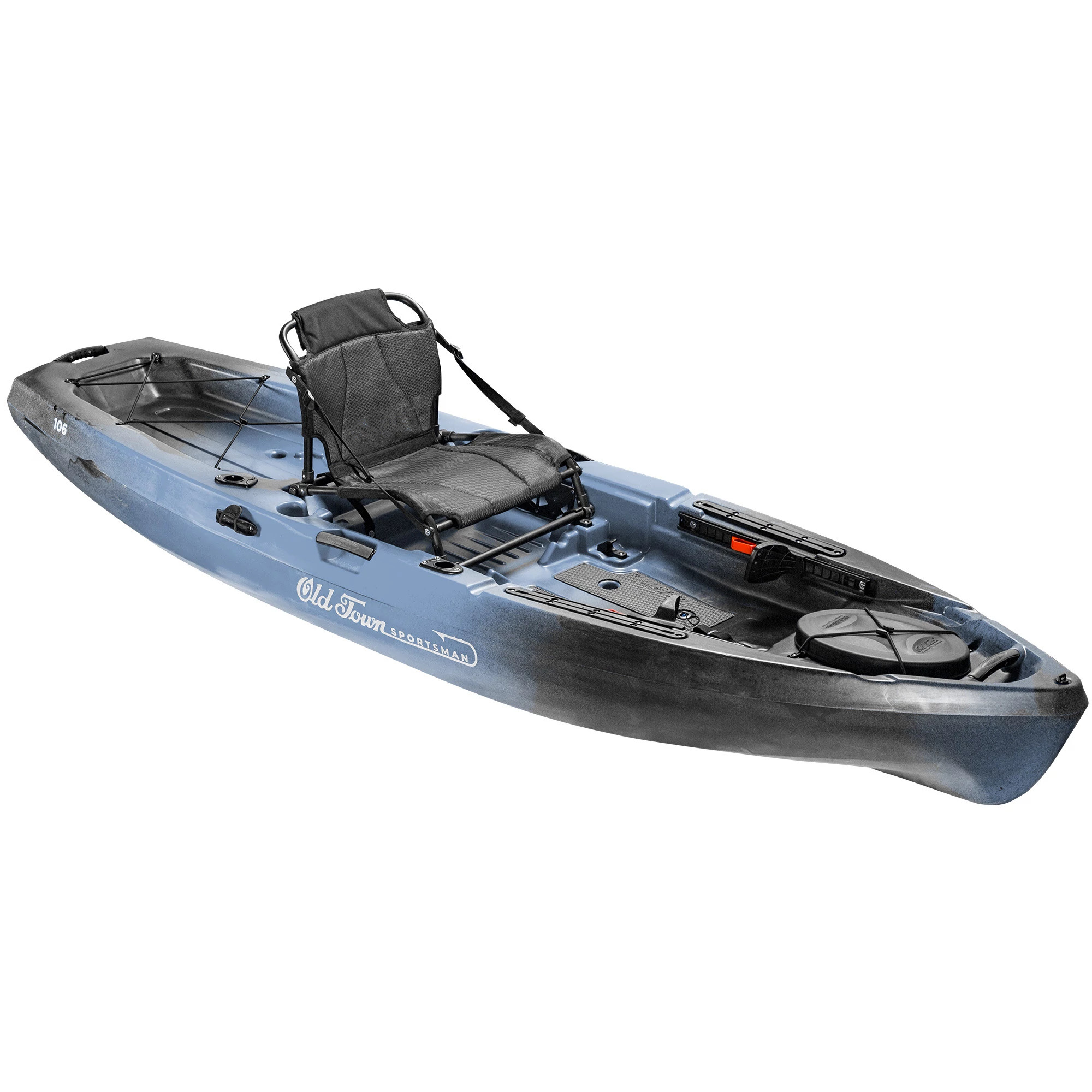
10’6″ · ~31.5″ wide · ~68 lbs · 400 lb capacity · ~$899 · Paddle not included
Old Town has been building kayaks since 1898, and it shows in how the Sportsman 106 is put together. The fit and finish is noticeably better than anything in the sub-$800 bracket — tighter seams, better seat hardware, a more refined hull design. The Comfort Flex seat is legitimately comfortable: mesh back panel, multiple adjustment points, and it doesn’t fight your posture the way a fixed-position seat does. The 400 lb weight capacity leaves real headroom for an average-sized angler with gear.
Multiple rod holders, integrated accessory tracks, and a large rear tank well give you a platform that’s ready to grow with your setup. The trade-off for all of this fit and finish is that the Sportsman 106 is narrower than the Pelican Catch Mode or the Outlaw 11.5 — at approximately 31.5 inches, it tracks more efficiently but feels slightly less planted on first sits. Most beginners adjust within an hour on the water. If you’re particularly sensitive to initial stability, the Outlaw 11.5 is the safer call. If you want a kayak with better long-term build quality you’ll still be fishing in five years, this is it.
Best for: Anglers who want Old Town quality without jumping to the full Topwater price point. Also the right pick if you’re 175–220 lbs and want a kayak that performs closer to center in its design spec. Worth seeing alongside the Sportsman BigWater 132 in person at Bass Pro — the difference in hull quality and seat comfort is immediately obvious.
- Old Town build quality — better fit/finish than budget options
- 400 lb capacity with headroom for a full gear setup
- Integrated accessory tracks standard
- Narrower at ~31.5″ — slightly less initial stability than 33″+ options
- Paddle not included
7. Old Town Sportsman BigWater 132 — Built for Big Water
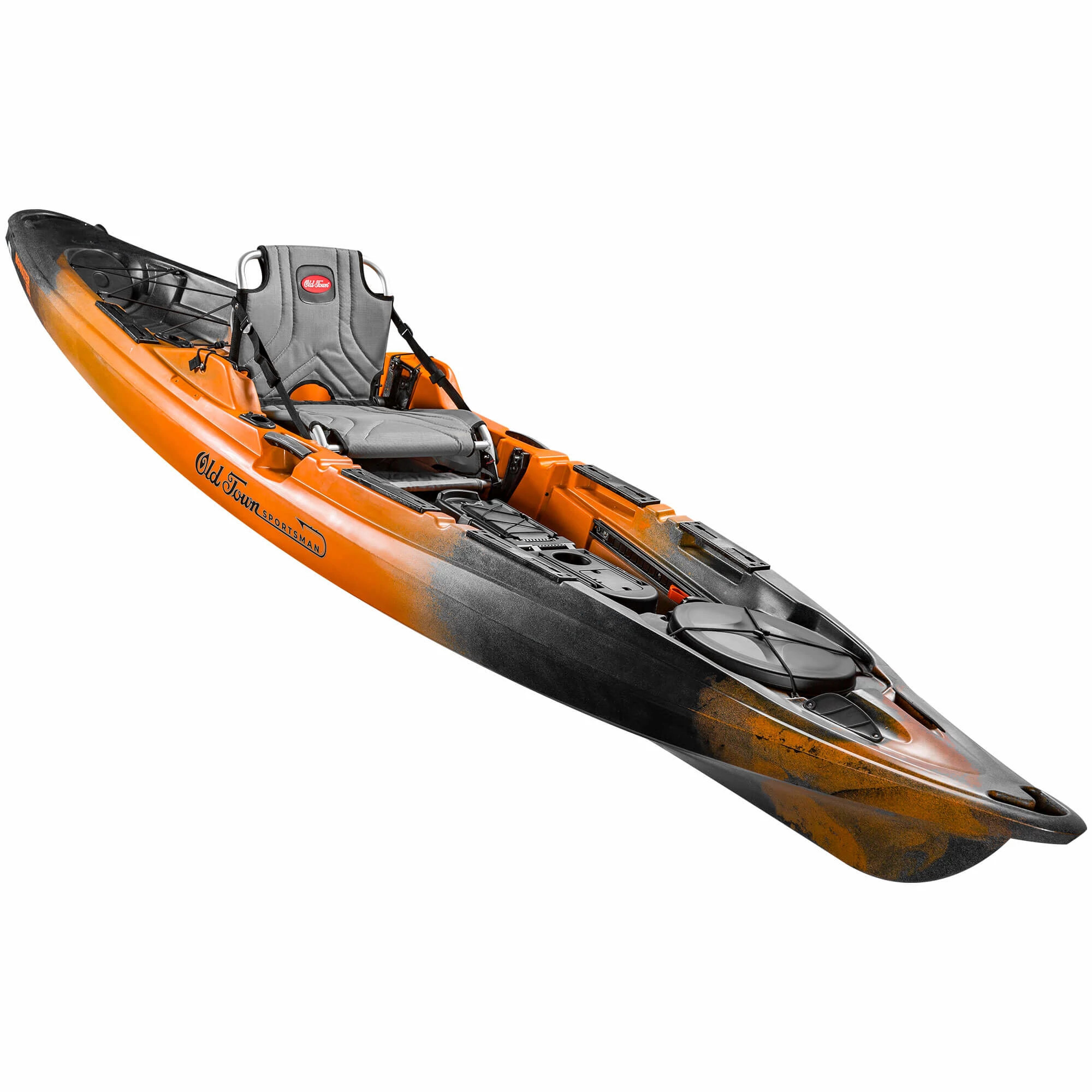
13’2″ · 34″ wide · 86 lbs · 425 lb total capacity · Check Amazon for current price · Paddle not included
The Old Town Sportsman BigWater 132 is built for one job: fishing large, open Oklahoma water from a solo kayak. At 13’2″ long with a 34-inch beam, it’s Old Town’s dedicated big-water paddle fishing platform. The longer hull tracks across open water more efficiently than anything shorter on this list — you’ll cover the main basin of Texoma, Eufaula, or Grand Lake with noticeably less effort, and the hull holds its line in a crosswind without constant correction. The 34-inch beam gives it meaningful primary stability on the kind of water where smaller kayaks feel out of their depth.
Old Town’s Element Seating System provides a tall back panel with multiple adjustable positions — comfortable for long days on big water. A bow hatch secures valuables, rod holders come pre-installed, and the hull accepts mounting hardware for fish finders and accessories. It’s available on Amazon, which makes it easier to acquire than the Sportsman BigWater 132 (manufacturer-only).
Best for: Anglers who regularly fish large Oklahoma reservoirs — Texoma, Eufaula, Grand Lake, Tenkiller — and want a paddle kayak that belongs on big water. The 86 lb hull is the real trade-off: you need a quality kayak cart, a truck bed, or a second person to load it solo. Plan your gear load carefully too — the 425 lb total capacity (339 lb usable after the boat’s own weight) leaves less headroom than it looks on paper.
- Longest hull on this list (13’2″) — best big-water tracking
- 34″ wide — wider than the Sportsman BigWater 132, solid open-water stability
- Available on Amazon with affiliate pricing
- Heaviest on this list at 86 lbs — needs a cart or second person
- 425 lb total / 339 lb usable capacity — plan your gear load carefully
What to look for in a beginner fishing kayak
Beam width is the number that matters most
Stability in a kayak comes primarily from width — the technical term is “beam.” For beginners, a minimum of 31 inches is workable on calm water; 33–34 inches is where most anglers feel genuinely planted. If you want to eventually stand and sight-fish, you need 34 inches or wider, full stop. Hull shape also plays a role: tunnel hulls (like Pelican’s design) and DoubleU hulls (Old Town) deliver better secondary stability than simple flat-bottoms at equivalent beam widths. Primary stability — how planted the kayak feels sitting still — matters most to beginners; secondary stability — how it recovers when leaned — matters more as you progress.
Sit-on-top is the right call for beginners
For fishing, sit-on-top kayaks are the correct choice at every experience level. They self-drain through scupper holes, they’re easier to re-enter from the water after a capsize, and they keep your gear accessible. Sit-in kayaks are faster and better for cold-weather touring, but they’re harder to get out of quickly and require a spray skirt for cold water protection. Every kayak on this list is a sit-on-top. That’s not an accident.
What you genuinely don’t need yet
A fish finder will not catch fish for a beginner — learning to read water visually first is more valuable and those skills transfer. A trolling motor adds weight and battery management complexity before you’ve learned the water. Pedal drive kayaks start at $1,700–$2,700 and add mechanical systems that can fail; they’re worth considering after your first full season when you know exactly what kind of fishing you do. The beginner trap is spending $4,000 on setup and being intimidated to put the thing in the water. Buy the kayak. Fish it. Rig it slowly as you figure out what you actually need.
Frequently asked questions
Two kayaks on this list include a paddle:
- Lifetime Tamarack Angler 100
- Pelican Catch Classic Angler (on most color variants — verify before ordering)
These kayaks all require a separate paddle purchase: Pelican Sentinel 100X Angler, Pelican Catch Mode 110, Perception Outlaw 11.5, Old Town Sportsman 106, Old Town Sportsman BigWater 132. Budget $60–$100 for a decent starter paddle. Match paddle length to your kayak width: 230 cm for kayaks under 33″ wide; 240 cm for wider hulls.