
Some links in this article are affiliate links. If you make a purchase through them, we may earn a small commission at no extra cost to you. This helps support the site. Learn more.
Guide last updated: May 5, 2026
A buddy of mine capsized on the Arkansas River near Webbers Falls a few years back. He was alone, his yak flipped in a wake from a passing bass boat, and the only reason he’s still around to tell the story is that he was wearing his PFD. He didn’t lose his life — he lost his net, a tackle box, and some pride. The gear can be replaced. That’s the whole conversation around PFDs for kayak fishing, right there.
Here’s the thing most generic life jacket guides miss: a fishing-specific PFD is genuinely different from a paddling vest. When you’re spending six hours on Grand Lake or Lake Texoma, you need something you’ll actually wear — not something you’ll peel off after 20 minutes because it’s hot or bunching up under your arms when you cast. The right fishing PFD has low-profile sides so you can crank a baitcaster, a mesh back so you don’t cook in the August heat, and pockets where you actually want them. It’s the difference between a PFD hanging on the back of your kayak and one you’re wearing all day.
Solo anglers especially need to take this seriously. Oklahoma has some of the busiest recreational lake traffic in the south — Grand Lake O’ the Cherokees on a summer weekend looks like a highway interchange. Wake boats, pontoons, jet skis — they come out of nowhere, and a kayak sits maybe 10 inches off the water. You’re invisible to half those people. If something goes sideways, nobody’s watching out for you but you. These are the PFDs worth putting your money into.
| PFD | Price | Rating | Type | Best For |
|---|---|---|---|---|
| Onyx MoveVent Dynamic | ~$55 | 4.7 ★ (1,400+ reviews) | Type III | Budget, casual anglers |
| NRS Chinook Fishing PFD | ~$160 | 4.8 ★ (107+ reviews) | Type III | All-day comfort, serious anglers |
| Stohlquist Fisherman PFD | ~$140 | 4.7 ★ (500+ reviews) | Type III | Max fishing features, workstation pockets |
Our Top Picks
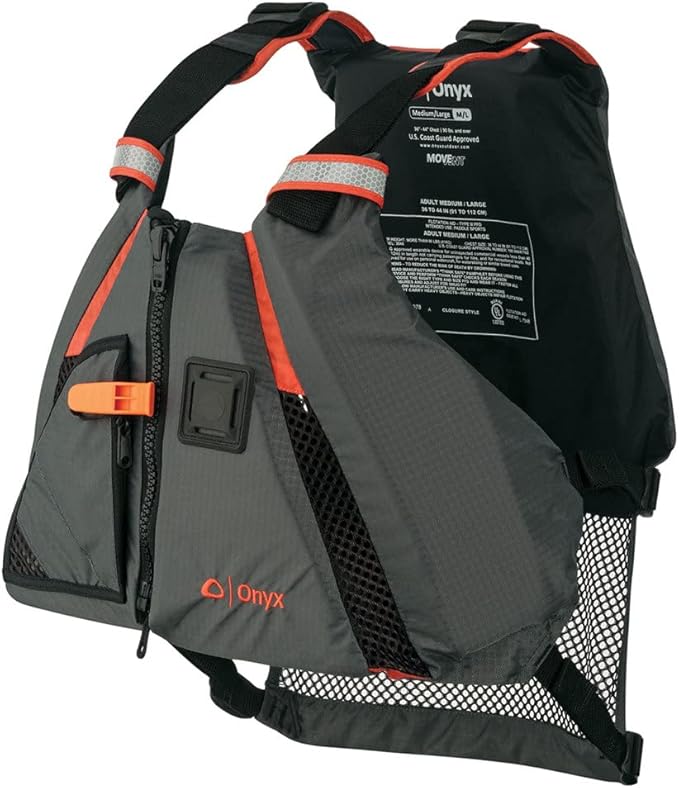
1. Onyx MoveVent Dynamic Paddle Life Vest — Best Budget Pick
ASIN: B00FI3F9XM | Price: ~$55 | Rating: 4.7★ (1,400+ reviews)
If you’re just getting into kayak fishing or you want a solid everyday PFD that won’t break the bank, the Onyx MoveVent Dynamic is where most people start — and a lot of experienced anglers stick with it. It’s a Coast Guard-approved Type III vest with a ventilated mesh back that actually makes a difference when you’re baking on an Oklahoma reservoir in July. The MoveVent name comes from its open-sided design that lets your arms move freely for casting without that binding, chafing feeling you get from cheap vests.
It’s not loaded with fishing-specific pockets like the NRS or Stohlquist, but it has two front pockets that work fine for a few small tackle items or a phone. The high-back design clears most kayak seats without a problem. At $55, it’s the easiest recommendation for new kayak anglers who just need a good, wearable PFD before they upgrade.
- US Coast Guard Type III approved
- Ventilated mesh back for heat management
- Shoulder and side adjustments for a snug fit
- High-back design fits most kayak seats
- Two front pockets
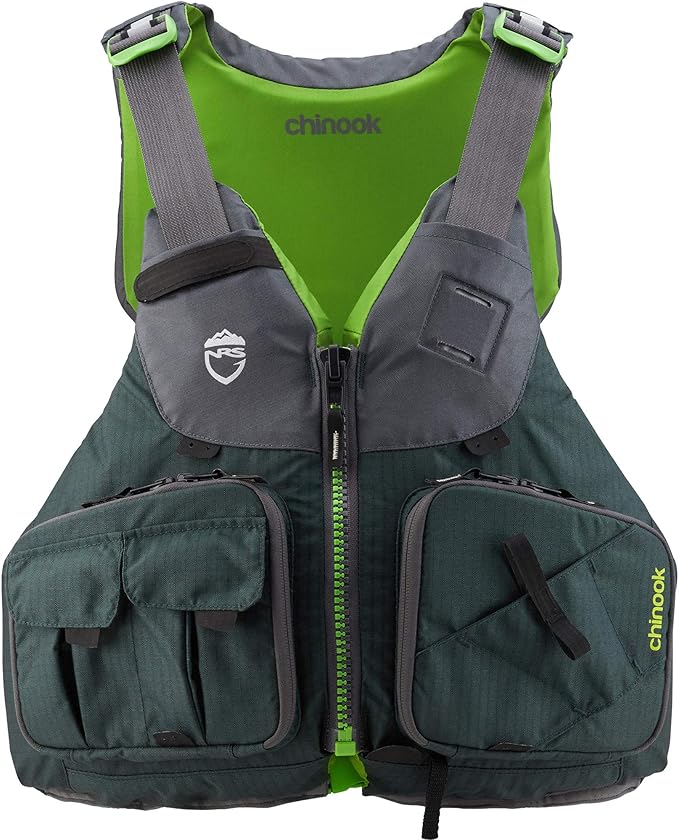
2. NRS Chinook Fishing PFD — Best All-Day Comfort
ASIN: B07M62DRXT | Price: ~$160 | Rating: 4.8★ (107+ reviews)
The NRS Chinook has been called the world’s best-selling fishing life jacket, and it earns that reputation. This is the PFD you buy when you spend full days on the water and you want something that genuinely doesn’t get in your way. The Orbit Fit System uses layered, pre-curved foam that conforms to your body rather than forcing your body to conform to it — after a couple of hours on the water you stop noticing it’s there, which is exactly what you want.
For Oklahoma summer fishing, the mesh lower back is a real feature. You’re not sweating through a solid foam panel all day. The clamshell pockets are sized for small tackle boxes or fly boxes, and the dedicated tool pocket with hook-and-loop closure keeps pliers right where you need them. Rod holder, strobe attachment point, reflective accents — this thing is built for people who take fishing seriously. It’s $100+ more than the Onyx, but if you’re on the water three or four times a week, the difference in comfort alone is worth it.
- Type III, 16.5 lbs flotation
- Orbit Fit System with pre-curved foam for all-day comfort
- Mesh lower back — major heat management advantage
- Two large clamshell tackle pockets + tool holder pocket
- Integrated rod holder and strobe attachment point
- Six adjustment points, YKK zipper entry
- Recycled ripstop nylon shell
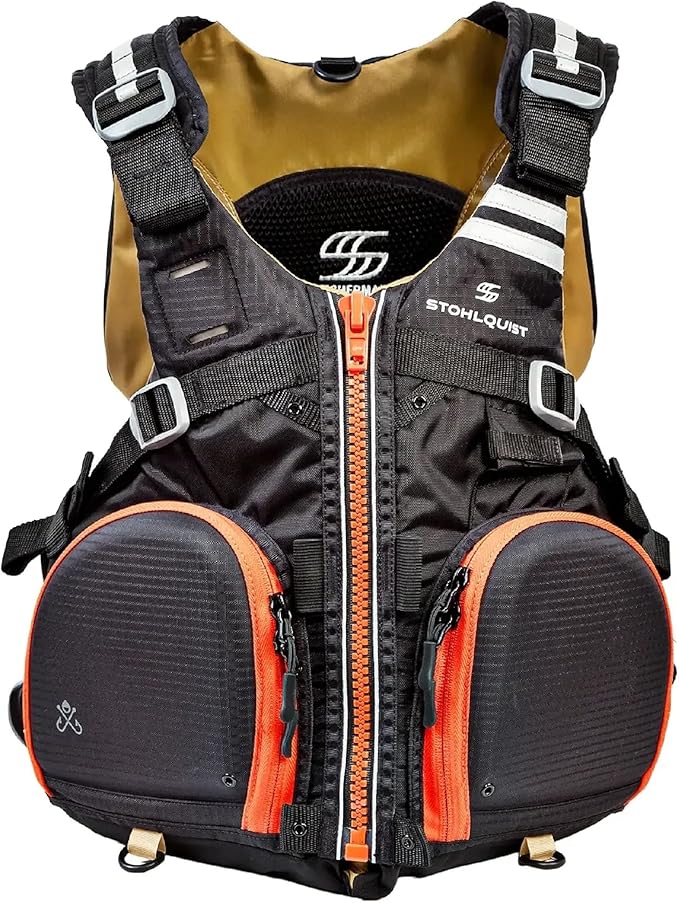
3. Stohlquist Fisherman PFD — Best Fishing Features
ASIN: B0GHZJR5N2 | Price: ~$140 | Rating: 4.7★ (500+ reviews)
The Stohlquist Fisherman is the choice for anglers who want their PFD to double as a fishing vest. The two large 7.5″ x 7.5″ clamshell pockets fold down into a handy workstation — you can rig leaders, swap jigs, or sort soft plastics without digging through a box. Inside those pockets you get D-rings, mesh pouches, and sewn attachment loops. Then there are external D-rings, bungee holders, and even more attachment points for tools. This thing carries more organization options than some dedicated fishing vests.
Stohlquist also gave this vest 16.75 pounds of flotation — slightly more than the Onyx and NRS — which matters when you’re loading pockets with gear that adds weight. The cross-chest cinch strap keeps it from riding up when you lean forward to net a fish, and the high-back design works with tall kayak seats. If you’re catfishing on Eufaula or bass fishing on Lake Thunderbird and you want everything accessible, this is the PFD to look at.
- Type III, 16.75 lbs flotation — highest in this group
- Two large fold-down workstation pockets
- Multiple D-rings and attachment points for tools and accessories
- Cross-chest cinch strap prevents ride-up
- High-back design compatible with tall kayak seats
- Available in S/M through XXL
What Makes a Fishing PFD Different From a Regular Life Jacket
Not all life jackets are built the same. A standard paddling vest keeps you afloat, but a fishing-specific PFD is designed around what you actually do on the water for 6-8 hours at a time.
Pocket Layout
Fishing PFDs put pockets where paddling vests don’t. Lower front pockets with clamshell or fold-down designs give you quick access to pliers, forceps, small tackle, and fishing line without opening a dry bag or reaching behind you. The dedicated tool pockets with retention straps and D-rings are things you simply don’t find on generic kayak vests. When you hook a 5-lb bass and need to unhook it without losing the fish or the hooks, that pocket layout matters.
Mobility for Casting
The open-sided designs on fishing PFDs — the cut-away armholes and contoured side panels — make a noticeable difference when you’re throwing a spinnerbait or working a crankbait all morning. Standard life vests bind up under your arms and restrict the follow-through on your cast. Fishing PFDs are engineered around that rotational movement so you can work a full day without shoulder fatigue or chafing.
Mesh Back Panels for Summer Heat
Oklahoma summer heat is not a joke. When you’re on Grand Lake in July, the water temp is 85°F and the air temp is 98°F. A solid foam PFD back traps heat and makes you miserable enough to take the thing off — which defeats the whole purpose. The mesh back panels on the NRS Chinook and similar fishing PFDs create airflow between the vest and your back. It’s the single most underrated feature for warm-weather kayak fishing.
Oklahoma-Specific PFD Considerations
Oklahoma kayak anglers deal with some conditions that generic PFD guides don’t account for. Here’s what actually matters in this state.
Summer Heat — Mesh Back Matters Here
The combination of Oklahoma heat, humidity, and direct sun on open water makes heat management a real concern. The difference between a mesh-back and solid-back PFD in those conditions isn’t just comfort — it’s the difference between wearing your PFD for 8 hours versus taking it off by noon. Every fishing PFD in this guide has a mesh or ventilated back for that reason. If you’re shopping outside this list, make that a non-negotiable.
Boat Traffic on Grand Lake and Texoma
Grand Lake O’ the Cherokees and Lake Texoma see heavy recreational boat traffic on weekends. Wakes from bass boats and pontoons can be surprisingly aggressive for a kayak angler sitting low on the water. This is exactly the situation where a PFD that fits snugly — one you’re actually wearing and have properly adjusted — is the difference between a scary moment and a recovery. The Stohlquist’s cross-chest cinch and the NRS Chinook’s Orbit Fit System both lock the vest in place when you’re swimming, rather than riding up around your chin. That matters on busy water.
Solo Fishing — When to Double Down on Safety
A lot of Oklahoma kayak anglers fish alone — smaller private ponds, creek arms off the main lake, dawn catfish runs before anyone else is out. When nobody knows where you are and nobody’s watching, your PFD isn’t optional. Consider pairing your PFD with a waterproof phone case, a whistle clipped to your vest (required by federal law on personal watercraft), and letting someone know where you’re fishing and when you’ll be back. The PFD is the foundation, but solo safety is the whole structure.
Frequently Asked Questions
Oklahoma law requires that all watercraft — including kayaks — carry one Coast Guard-approved PFD for each person on board. For kayakers, that means keeping a wearable Type III or Type V PFD on board at minimum. Children under 13 must wear their PFD at all times while on the water. Adults aren’t legally required to wear it, but given the conditions on Oklahoma’s bigger lakes, actually wearing it is the smart move.
Type III PFDs — like all three picks in this guide — are inherently buoyant foam vests approved for calm or inland water. They require you to be conscious and swimming to keep your face clear of the water. Type V PFDs include inflatable designs that offer more mobility and less bulk, but require manual inflation and regular maintenance. For kayak fishing in Oklahoma’s freshwater lakes, a well-fitting Type III fishing PFD is the practical standard choice for most anglers.
A regular paddling PFD will keep you safe, but a fishing-specific PFD will keep you comfortable. The difference is in the pocket layout, arm mobility, and heat management. If you’re fishing for a full day in Oklahoma summer heat, you’ll notice the difference within the first hour. A fishing PFD is worth the extra $30-$50 over a basic paddle vest for anyone who fishes more than casually.
A properly fitting PFD should be snug but not restrictive — you should be able to take a full breath comfortably. After adjusting all the straps, have someone pull up on the shoulders of the vest. If it rises above your chin or ears, it’s too loose and needs to be tightened or sized down. All three PFDs in this guide have multiple adjustment points precisely because fit matters more than most people realize.
With proper care, a quality foam PFD like these should last 5-10 years. Replace it if the foam becomes waterlogged and doesn’t recover its shape, if the outer fabric is severely worn or torn, or if any buckles or zippers fail. Always store your PFD out of direct sunlight and let it air dry completely before storage. Oklahoma’s UV exposure can degrade materials faster than you’d expect, so inspect your vest at the start of each season.
Related Guides
Just getting started? Our best fishing kayaks for beginners guide breaks down the top boats for every budget and fishing style.