
Some links in this article are affiliate links. If you make a purchase through them, we may earn a small commission at no extra cost to you. This helps support the site. Learn more.
Guide last updated: May 5, 2026
If you’ve spent any time on the r/kayakfishing forums, you know exactly how this goes. Someone asks whether to get the Garmin Striker Vivid 7sv, the Humminbird Helix 7, or the Lowrance Eagle 7 TripleShot — and suddenly they’re three hours deep in a rabbit hole, more confused than when they started. The honest answer most experienced yak anglers will give you: at this price point, they’re all solid. The real question is which one fits your fishing style and your rig.
Oklahoma kayak anglers have some of the best water in the country to work with — from the shallow flats of Keystone to the clear points of Grand Lake, the sprawling structure of Eufaula, and the big-water ledges of Lake Texoma. Each of those fisheries rewards a slightly different sonar setup. A unit with solid side imaging makes covering Eufaula’s standing timber feel effortless. A budget CHIRP unit on Grand Lake will still put you on bass if you know the channel swings. This guide cuts through the noise and tells you what actually matters when you’re rigging out your yak.
One note on pricing: the Garmin Striker Vivid 7sv sits at $519.99 list — technically over the “$500” line. We included it anyway because it shows up on nearly every top-10 list for a reason, it’s frequently on sale, and it’s the unit Oklahoma tournament anglers keep recommending on Facebook groups. The other picks in this guide all land under $500.
Quick Comparison: Best Kayak Fish Finders 2026
| Model | Type | Price | Display | Best For |
|---|---|---|---|---|
| Garmin Striker Vivid 4cv | CHIRP + ClearVü | ~$200 | 4″ QSVGA | Best budget, first fish finder |
| Garmin Striker Vivid 7sv | CHIRP + SideVü + ClearVü | ~$495–$520 | 7″ WVGA | Best overall, big water |
| Humminbird Helix 7 CHIRP SI G4 | CHIRP + Side Imaging + Down Imaging | ~$495 | 7″ 800×480 | Best value, community favorite |
| Lowrance Eagle 7 TripleShot | CHIRP + SideScan + DownScan | ~$400–$450 | 7″ IPS 800×480 | Best charts, Texoma/Grand Lake |
Garmin Striker Vivid 4cv — Best Kayak Fish Finder to Start With
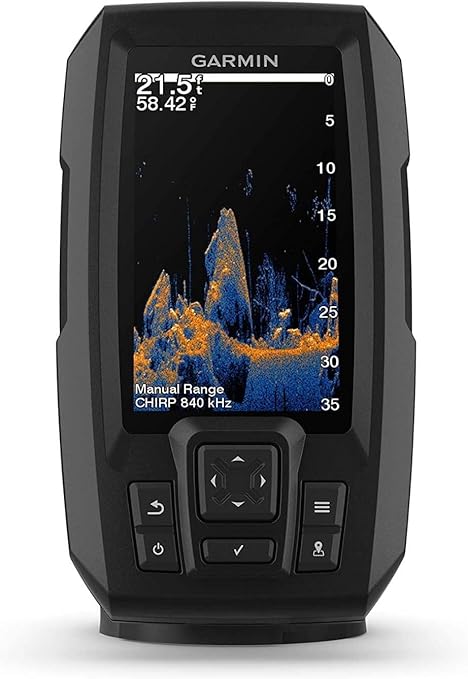
$199.99 · 4-inch QSVGA display · CHIRP + ClearVü sonar · 4.7★
If you’re new to kayak fishing and want to know if a fish finder is even worth adding to your setup before dropping $500 on one, start here. The Striker Vivid 4cv comes in at $199 and gives you real CHIRP sonar, ClearVü down-scanning, high-sensitivity GPS, and Garmin’s Quickdraw Contours mapping — all in a package small enough to mount on a RAM ball without adding much weight or clutter to your yak. For fishing Oklahoma’s smaller reservoirs, farm ponds, or rivers, this unit is everything you need.
The 4-inch display is the main compromise. It’s genuinely readable in normal conditions, but you’ll notice the size difference compared to a 7-inch unit when you’re trying to read bottom detail at speed. That said, dozens of Oklahoma kayak anglers have put serious time on this unit on Keystone, Skiatook, and the smaller Corps of Engineers lakes and done just fine. The 4cv gets you CHIRP and ClearVü down imaging — no side scan — which is perfectly adequate for most kayak fishing situations where you’re closer to cover anyway.
The GT20-TM transducer included with the 4cv mounts on a transom bracket or trolling motor arm and handles 50/200 kHz traditional sonar plus 455/800 kHz ClearVü. The unit is IPX7 waterproof, runs on 10-17V DC (easy to power from a small sealed lead-acid or LiFePO4 battery), and the full unit weight is under 12 ounces. If you outgrow it later, the Garmin ecosystem means you can move up to a 7sv and the experience translates directly.
Garmin Striker Vivid 7sv — Best Overall Pick
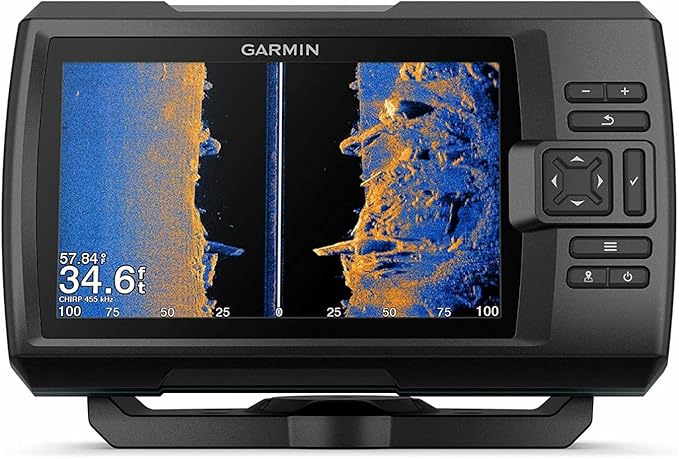
$495.99–$519.99 · 7-inch WVGA display · CHIRP + SideVü + ClearVü sonar · 4.7★ (1,998 reviews)
The Striker Vivid 7sv is the unit you see on more Oklahoma kayaks than anything else right now, and that’s not by accident. The 7-inch screen is genuinely readable in bright Oklahoma summer sun — something the smaller units can’t always say. SideVü scanning sonar gives you a horizontal view that’s particularly useful when you’re drifting the submerged timber fields on Eufaula or searching the deep channel edges on Texoma. The GT52HW-TM transducer handles traditional CHIRP, ClearVü (down scanning), and SideVü all in one installation — which means one hole in your hull or one transducer arm on your RAM mount, and you’re covered.
Garmin’s Quickdraw Contours feature is the hidden gem here. As you paddle, the unit maps the bottom in real time with 1-foot contour lines and stores up to 2 million acres of your own custom maps. For Oklahoma waters like Keystone where good contour maps can be hard to find, being able to build your own chart over a season of fishing is legitimately valuable. The high-sensitivity GPS locks fast and tracks your trolling speed accurately enough to tell the difference between crawling and dragging.
Yes, it’s slightly over $500 at full retail — but it’s consistently available for $495 to $510 on Amazon and frequently goes lower during Prime sales. For a first serious yak fish finder setup, this is the one most experienced anglers in the Oklahoma community point you toward. Pair it with a small LiFePO4 battery and a RAM ball mount, and you’ve got a complete rig that’ll last years.
Humminbird Helix 7 CHIRP SI GPS G4 — Best Value, Community Favorite
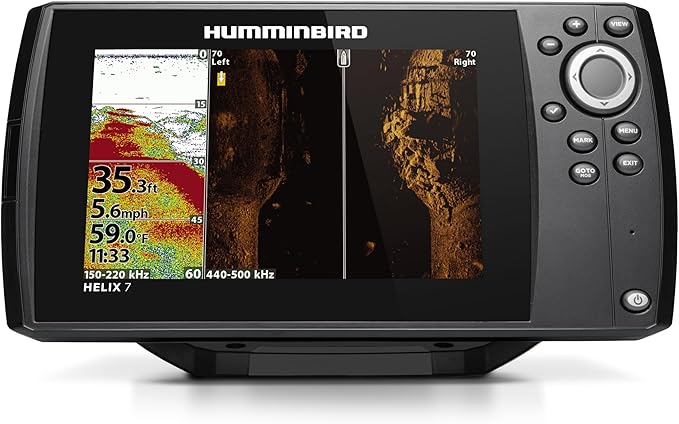
$494.99 · 7-inch 800×480 display · CHIRP + Side Imaging + Down Imaging · 4.6★ (161 ratings)
If Garmin is the Chevy of kayak fish finders, Humminbird is the Ford — and the Helix 7 is the pickup truck every serious bass angler knows. The side imaging on this unit is class-leading at this price point. Humminbird’s SI technology produces sharper, more detailed side scan images than the competition in this range — the kind of images where you can actually identify individual stumps in a timber field, not just blurry blobs. For Grand Lake’s laydowns and Eufaula’s flooded standing timber, that clarity makes a real difference when you’re trying to decide where to drop a jig.
The Helix 7 G4 runs on Humminbird’s CHIRP sonar with 2D, Down Imaging, and Side Imaging all available from a single unit. The screen is a crisp 800×480 display that reads well in most lighting conditions. Where Humminbird earns its reputation is in the software — the menus are intuitive, the SI images are clean, and the GPS chartplotter integration works smoothly. The unit supports AutoChart Live, which, like Garmin’s Quickdraw, lets you build custom maps of your local water while you fish.
The Reddit kayak fishing communities consistently call the Helix 7 the “benchmark mid-range choice,” and it shows up in serious tournament rig lists — one popular Oklahoma tournament setup put the Helix 7 SI at the center of a $1,992 complete kayak fishing build. At around $495, it hits the same price as the Striker Vivid 7sv but with arguably better side imaging performance. If you’re fishing timber-heavy water and side scan clarity is your top priority, the Helix 7 deserves serious consideration.
Check Price on AmazonLowrance Eagle 7 TripleShot — Best for Charted Waters
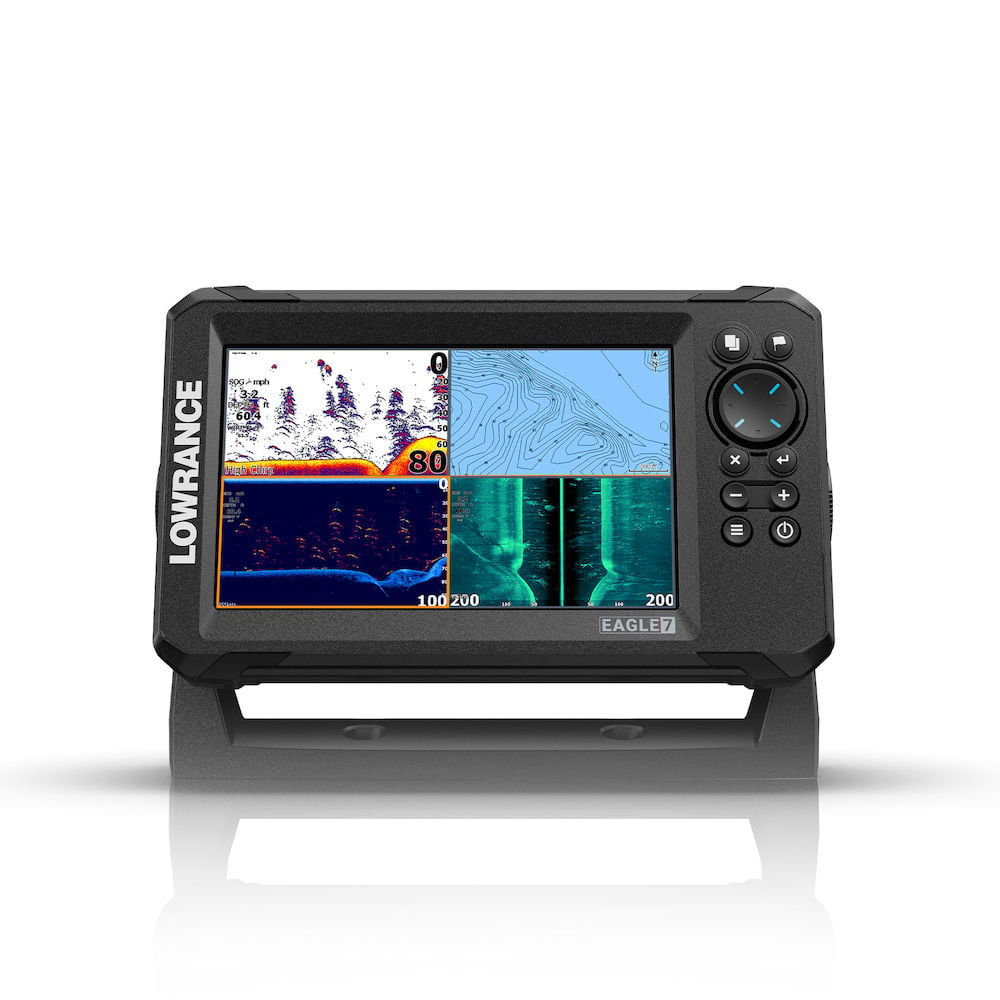
~$399–$450 · 7-inch IPS 800×480 display · CHIRP + SideScan + DownScan + C-MAP charts · 4.5★
The Lowrance Eagle 7 TripleShot is the outlier in this comparison in the best possible way: it comes with detailed C-MAP inland charts preloaded out of the box. On Oklahoma lakes like Texoma and Grand Lake — where accurate depth charts and structure maps are available and genuinely useful — having charts built in from day one changes how you fish. You’re not just looking at raw sonar returns; you’re seeing your sonar overlaid on actual contour maps, immediately placing fish targets in the context of known structure.
The TripleShot transducer bundles CHIRP, SideScan (up to 600 feet each side), and DownScan Imaging into a single installation. Lowrance’s FishReveal technology overlays CHIRP target returns on top of the DownScan image, so you can see both the structure and the fish at the same time — no switching between views. The IPS display is noticeably bright and readable from wider angles than older LCD panels, which matters when the sun is hammering down on Texoma in July and your screen is mounted off to the side of your yak.
At $399 to $450 on Amazon, the Eagle 7 TripleShot is consistently the most affordable 7-inch side scan unit in this comparison. Lowrance’s Genesis Live mapping works the same way as Quickdraw and AutoChart Live — it builds custom 1/2-foot contour maps as you paddle. The twist-lock connector system also makes it quick to pull the unit off between trips without tools. If you want a charted, 7-inch side-scan setup for under $450, this is the pick.
Check Price on AmazonHow to Mount a Fish Finder on a Kayak
Buying the right unit is only half the job. Getting it mounted securely, positioned where you can actually read it, and powered reliably is where most new kayak anglers run into trouble. Here’s what actually works.
RAM Mounts vs. Scotty Mounts
Both systems work well — the choice usually comes down to what track system your kayak already has. RAM mounts use a ball-and-socket system that lets you position the unit exactly where you want it and adjust it on the fly. Most kayak anglers running Garmin or Humminbird units on rod-rigged yaks use a RAM 1-inch ball mount on a RAM track base, with a RAM mount arm and the appropriate cradle for their unit. Scotty mounts use a simpler button-release post system that’s popular on older SOT kayaks with Scotty tracks.
Both are sturdy enough for anything under 10-inch displays. For anything 7 inches and under — which covers everything in this guide — either system works. Buy the version rated for your display size; going too small on the arm length means the unit will be hard to read at a normal paddling position.
Transducer Placement on a Kayak
For most kayaks, the transducer goes through the scupper hole (a “shoot-through” transducer) or on a transducer arm mounted to the side or stern of the hull. Shoot-through works reasonably well with kayak hulls if you don’t have serious hull hardware in the way, but you’ll lose some sonar sensitivity — typically not enough to matter on water under 60 feet deep, which covers most Oklahoma lakes. A dedicated transducer arm keeps the transducer in clean water outside the turbulence zone under the hull and gives you full performance. RAM makes a scupper-mounted transducer arm that installs without drilling and holds the transducer at the right angle. Keep the transducer cable secured along the gunwale with zip ties so it doesn’t snag your paddle or lines.
Powering Your Fish Finder (Battery Options)
Garmin, Humminbird, and Lowrance units in this guide all run on 12V DC. Your options are a small sealed lead-acid (SLA) battery — cheap, heavy, 7Ah to 12Ah covers a full day on any unit in this guide — or a lithium iron phosphate (LiFePO4) battery, which weighs significantly less and tolerates deeper discharge. A 10Ah LiFePO4 battery weighs about 2.5 pounds and will run the Striker Vivid 7sv for 15+ hours.
Popular options for kayak builds include the Dakota Lithium 10Ah and BattleBorn’s smaller LiFePO4 packs. Run the power wire along the inside of the hull to a waterproof inline fuse holder, and terminate with a power pole or Anderson connector for easy disconnect. Don’t skip the fuse — fish finders are sensitive electronics and a short in the wiring can damage them.