
Some links in this article are affiliate links. If you make a purchase through them, we may earn a small commission at no extra cost to you. This helps support the site. Learn more.
Guide last updated: May 5, 2026
Pull hard on the water for four hours straight out on Lake Eufaula and you will feel the difference between a good paddle and a bad one in your shoulders by noon. Most beginners grab whatever aluminum stick came with their yak — or whatever is cheapest on the shelf — without realizing that the paddle does about half the work. The blade angle, shaft material, and especially the paddle length all determine how tired you feel at takeout and how many casts you actually made while you were out there.
For Oklahoma anglers, paddle choice matters even more. Oklahoma wind is relentless. Paddling into a 15 mph headwind back to the ramp at Lake Hefner on a heavy aluminum paddle will grind your forearms down fast. The right paddle — properly sized, with the right blade design for low-angle fishing strokes — turns that same situation into manageable, rhythmic paddling instead of a workout you did not sign up for.
This guide covers three paddles we recommend for kayak anglers at different price points, and — more importantly — includes a paddle length guide you can actually use before you buy. Most product roundups skip this entirely. We did not, because the most common beginner mistake is buying a paddle that is either too short or too long for their kayak and body.
Fishing Paddle Comparison
| Paddle | Shaft Material | Length Options | Price | Best For |
|---|---|---|---|---|
| Carlisle Magic Angler | Wrapped Fiberglass | 230–250 cm | ~$109 | Budget / First paddle |
| Bending Branches Angler Classic | Fiberglass / Aluminum | 240–280 cm | ~$160 | Mid-range all-day fishing |
| Werner Skagit FG | Carbon Blend | 220–260 cm | ~$174 | Premium low-angle touring |
Paddle Length Guide — The #1 Thing Beginners Get Wrong
Here is the truth: “a paddle is a paddle” is the most expensive myth in kayak fishing. The correct length depends on how wide your kayak is and how tall you are. Fishing kayaks are often wide — 30 to 36 inches — because stability matters. That extra width means you need a longer paddle to reach the water without banging your knuckles on the gunwale every stroke.
| Kayak Width | Paddler Height | Recommended Length |
|---|---|---|
| Under 23 inches | Under 5’5″ | 210–220 cm |
| Under 23 inches | 5’5″ to 6’0″ | 220–230 cm |
| Under 23 inches | Over 6’0″ | 230 cm |
| 24–28 inches | Under 5’5″ | 220–230 cm |
| 24–28 inches | 5’5″ to 6’0″ | 230 cm |
| 24–28 inches | Over 6’0″ | 240 cm |
| 29–32 inches | Under 5’5″ | 230–240 cm |
| 29–32 inches | 5’5″ to 6’0″ | 240–250 cm |
| 29–32 inches | Over 6’0″ | 250 cm |
| Over 33 inches | Under 5’5″ | 240–250 cm |
| Over 33 inches | 5’5″ to 6’0″ | 250–260 cm |
| Over 33 inches | Over 6’0″ | 260 cm |
Most sit-on-top fishing kayaks sold at Bass Pro and Cabela’s fall in the 30–33 inch range. If you bought a 32-inch wide Lifetime, Old Town Topwater, or similar entry-level fishing yak, start at 240–250 cm regardless of what the basic paddle charts say. Those standard charts are built for narrow touring kayaks and will steer you wrong every time.
Best Budget Fishing Paddle: Carlisle Magic Angler 230cm
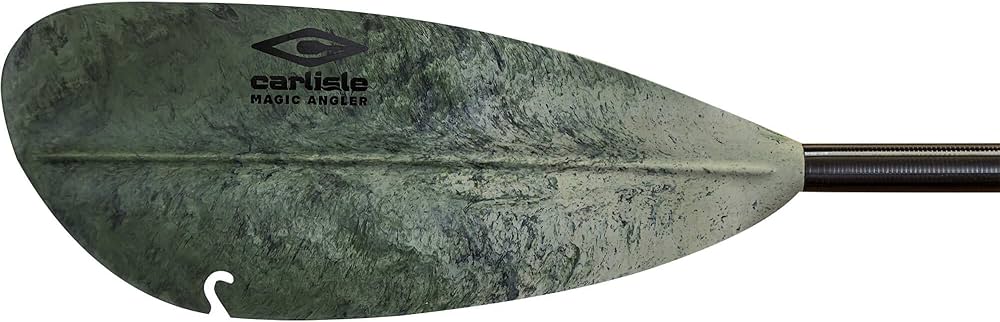
ASIN: B084LM6MRV | Price: ~$108.74 | Rating: 4.4★ (246 reviews)
The Carlisle Magic Angler is the paddle we point most beginners toward first. Fiberglass-wrapped shaft means it is noticeably stiffer than bare aluminum, which translates to a more efficient stroke — you put power in and you actually go forward, rather than losing energy to shaft flex. The camo colorway keeps things low-profile on the water, which does not hurt either.
The polypropylene blades are shaped specifically for fishing — a wider blade profile that catches water well even during the low-angle, relaxed stroke most kayak anglers use when they are covering water between spots. Drip rings are included. At 230 cm it fits most mid-width fishing kayaks (27–30 inch beam) with paddlers in the 5’6″ to 6’0″ range. If your yak is 31 inches or wider, size up to 240 cm.
This is the paddle currently featured in our Lake Hefner guide for good reason — it gets the job done for a full day without feeling punishing on your joints. At under $110, it is hard to argue with.
Check Price on AmazonBest Mid-Range Fishing Paddle: Bending Branches Angler Classic
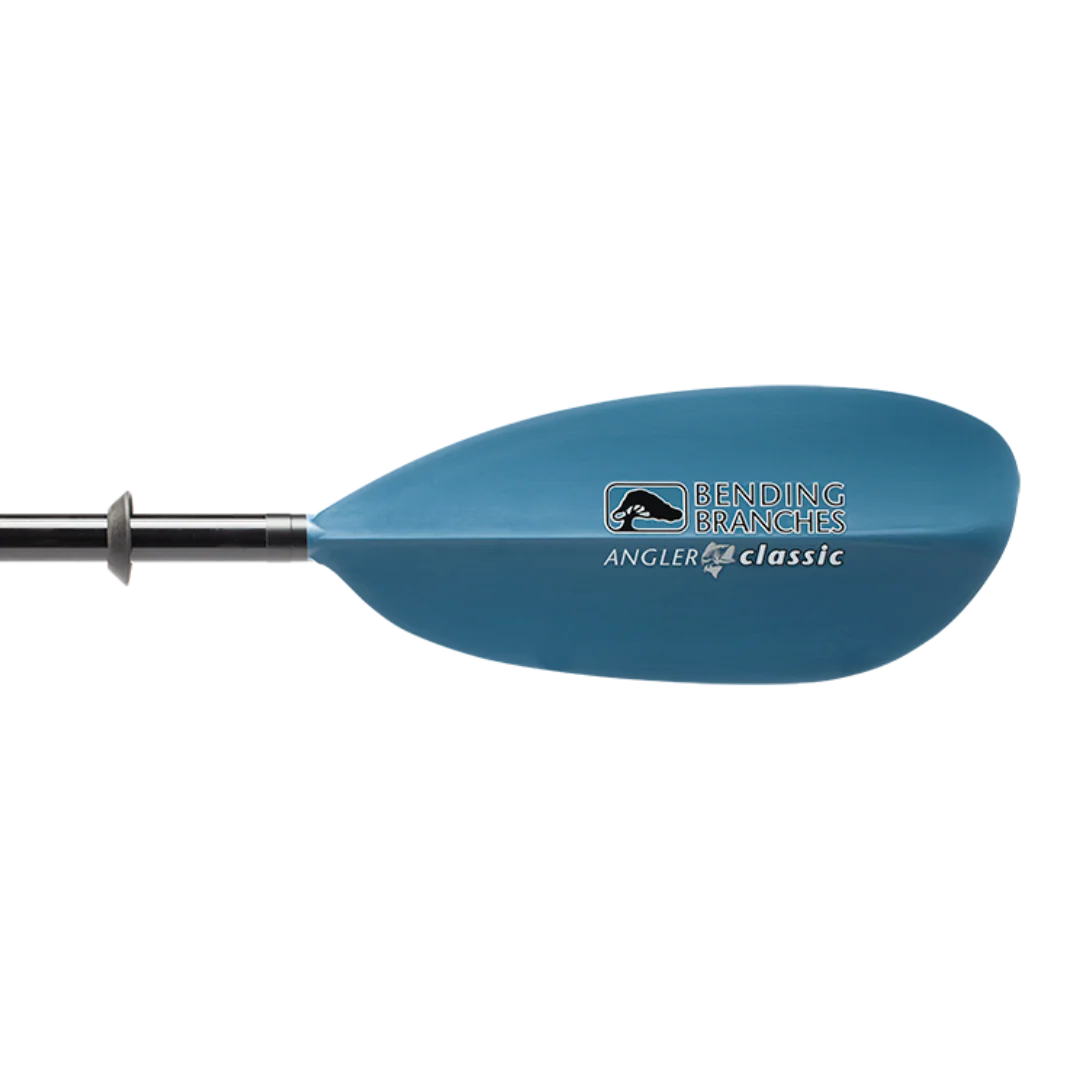
ASIN: B0BQKMWPML | Price: ~$159.95 | Rating: 4.5★
Bending Branches built the Angler Classic specifically for fishing kayakers, and it shows. The blade design includes a hook retriever notch — a small cutout in the blade tip that lets you flip a snagged lure out of a tree branch without having to beach the yak. That sounds like a gimmick until the third time you use it on a brushy Oklahoma impoundment and realize you just saved five minutes and kept from spooking the flat.
The snap-button two-piece system is rock solid and reassembles fast on the water. Shaft diameter runs slightly oval rather than round, which locks your grip into proper blade angle every stroke without having to think about it — this matters during a long day when fatigue starts setting in and your form gets sloppy. Available in lengths from 240 to 280 cm; most fishing kayak anglers will want 250–260 cm.
Made in the USA. Backed by a two-year manufacturing warranty. The step up in price from the Carlisle is real, but the day-long comfort difference is also real. If you fish two or more days a week, the Angler Classic earns its keep.
Check Price on AmazonBest Premium Fishing Paddle: Werner Skagit FG
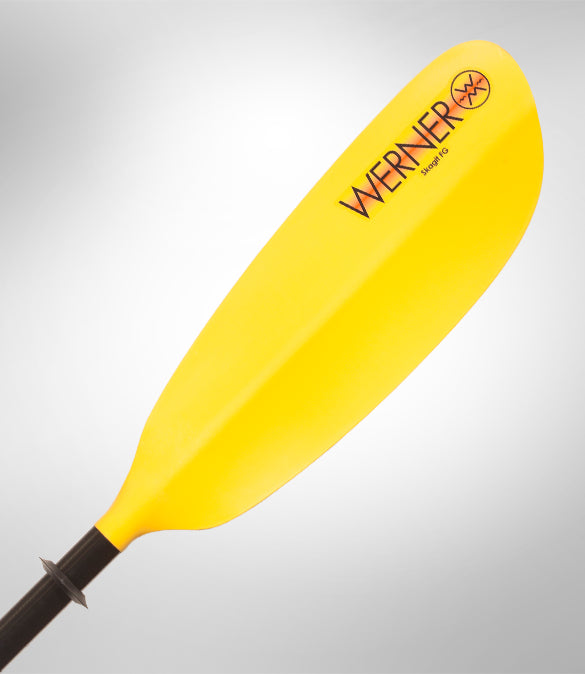
Price: ~$174 | Rating: 4.6★ (Outdoor Gear Lab: Best Buy Award)
Werner is the brand that serious paddlers eventually arrive at, and the Skagit FG is their gateway-level paddle that does not feel like a compromise. The carbon-blend shaft drops weight considerably compared to fiberglass or aluminum, and that weight saving compounds over a long day — lighter paddle, less fatigue, more energy in your arms for the actual fishing. The Smart View adjustable ferrule lets you dial in feather angle with precision, and it holds that setting without wobble or creep.
The mid-sized, low-angle blade is ideal for the long, sweeping strokes that fishing kayak anglers prefer — keeping your profile low while you cover water, not broadcasting your presence to the flat with high splashing strokes. This is the same blade philosophy as Werner’s much more expensive paddles, delivered at an approachable entry point into the brand.
At 953 grams and available in lengths from 220 to 260 cm, the Skagit FG is the paddle to buy if you are planning to put serious hours on the water — Eufaula weekends, multi-day floats, or any situation where you will be paddling against Oklahoma wind and current all day. Worth every dollar of the upgrade.
Check Price on AmazonWhat to Look for in a Fishing Paddle
Shaft Material — Aluminum vs. Fiberglass
Aluminum shafts are heavy and conduct cold — on an October morning on Canton Lake, an aluminum shaft feels like a steel pipe. They are fine for occasional use but cause more fatigue over a full day. Fiberglass shafts are lighter, stiffer, and do not conduct cold the same way. Carbon shafts are the lightest of all and offer the best power transfer but cost significantly more. For most fishing kayak anglers, fiberglass hits the sweet spot between performance and price. If budget is the primary concern, wrapped fiberglass (like the Carlisle) is a real step up from bare aluminum without a big jump in price.
Blade Shape — High Angle vs. Low Angle
High-angle paddles have shorter, wider blades designed for aggressive, vertical strokes — think whitewater or sprint paddling. Low-angle paddles have longer, narrower blades meant for relaxed, sweeping, horizontal strokes. Kayak fishing is almost universally a low-angle activity. You are not sprinting to a spot; you are cruising cover, holding position, and keeping your body relaxed for hours. Every paddle on this list uses a low-angle blade design. The blade angle label on the box matters — do not buy a high-angle paddle for fishing use unless you have a very specific reason.
Drip Rings — Keeping Your Lap Dry Matters on a Long Day
Drip rings are the rubber collars on the shaft near the blade end that catch water as it runs down the blade after each stroke and deflect it away from your hands and lap. A paddle without drip rings — or with worn ones — soaks your lap and gloves within the first twenty minutes. In Oklahoma, that matters most in April and October when the water is cold. Make sure any paddle you buy has functional drip rings and check their condition annually.
Paddling Oklahoma
Against Oklahoma Wind
Oklahoma averages some of the strongest sustained winds in the continental US, and those winds funnel across open reservoirs without any tree cover to break them. Paddling into a 20 mph headwind with a heavy aluminum paddle on Eufaula is a genuine endurance test. A lighter paddle — fiberglass or carbon shaft — reduces the energy cost of each stroke, which adds up fast when you are making two hundred strokes into a headwind. Proper paddle length also matters here: too short and you lose blade purchase; too long and you catch the wind during the recovery phase. Sizing correctly for your kayak removes one variable from a tough situation.
Shallow Water Poling vs. Paddling
Some Oklahoma anglers pole their yaks through shallow flats rather than paddle, using a single-blade setup or a dedicated push pole. There is real value in this for extremely shallow presentations — under 12 inches — where paddle strokes would push a bow wave. That said, for most fishing scenarios, a properly sized kayak paddle with a quiet, low-angle stroke disturbs far less water than most beginners assume. Practice your blade angle so it enters and exits the water cleanly, and you can work surprisingly shallow without spooking fish.
Why Kayak Anglers Prefer Low-Angle Strokes
The low-angle stroke keeps your paddle shaft nearly horizontal to the water surface, with your top hand not rising much above shoulder level. This accomplishes several things at once: lower paddle, less splash, quieter entry, and less body rotation required — which means your torso stays stable and you are less likely to roll the yak when you lean for a cast. The low-angle stroke is also the most sustainable for long days because it uses larger muscle groups (back and core) rather than isolating your arms. Every fishing-specific paddle on this list is designed to make the low-angle stroke more efficient.
Frequently Asked Questions
For most fishing kayaks — which run 28–34 inches wide — you need a longer paddle than standard sizing charts suggest. Use kayak width as your primary input: 28–30 inch wide yak, go 230–240 cm; 30–33 inch wide, go 240–250 cm; 33 inches or wider, start at 250 cm. Taller paddlers (over 6′) add 10 cm. Most beginners on wide sit-on-top fishing kayaks are best served by a 240–250 cm paddle, not the 220 cm paddle the generic charts recommend.
Yes, for most situations. A fiberglass shaft is lighter, stiffer, and warmer to the touch than aluminum. The weight difference feels minor in the store but compounds across hundreds of strokes on the water. A fiberglass paddle typically costs $30–60 more than a comparable aluminum paddle and is worth it if you fish more than a few times per season. The Carlisle Magic Angler uses a fiberglass-wrapped shaft and comes in under $110 — that is a reasonable entry point into the upgrade.
Feathering refers to offsetting the two blades of a two-piece paddle so they are not parallel — typically 30 to 60 degrees off axis. This reduces wind resistance on the out-of-water blade during the recovery phase of your stroke. In Oklahoma wind, some feathering can reduce fatigue noticeably. Many paddles on this list — including the Werner Skagit FG — offer adjustable feathering so you can experiment and find what works for your style. Most fishing kayak paddlers use 0 (unfeathered) or light feathering (15–30 degrees).
You can use any kayak paddle for fishing. Fishing-specific paddles — like the Bending Branches Angler Classic — add features like hook retrieval notches and ruler markings on the blade, which are genuinely useful but not strictly necessary. More important is getting the right length and blade angle for your paddling style. A well-sized regular touring paddle outperforms a poorly sized fishing paddle every time.
Check that your paddle has functional drip rings — the rubber collars near the blade end of the shaft. They intercept water running down the blade after each stroke and deflect it outward before it reaches your hands and lap. If your rings are worn or missing, replacement rings cost a few dollars and slide on in seconds. Beyond the rings, refining your blade angle so the paddle exits the water cleanly (rather than lifting a sheet of water) reduces drip significantly. A good low-angle stroke is naturally drier than a choppy high-angle one.
Related Guides
Just getting started? Our best fishing kayaks for beginners guide breaks down the top boats for every budget and fishing style.