
How to Find Fishing Spots on a Lake
A 5-step system for turning a lake you’ve never fished into three places worth investigating — no fish finder required.
To find good fishing spots on a lake, narrow the water down in stages: understand the lake’s overall shape and season first, pick a likely zone, find meaningful structure (points, humps, creek channels, breaks), then look for the specific feature inside that structure — a sharp edge, a channel swing, a depth change — where multiple good things line up. Compare candidates against four questions (structure, depth, route, complexity), pick three to fish, and give each about 20 focused minutes before deciding to stay or move.
You pull up a contour map of a lake you’ve never fished.
There are dozens of points. Creek channels wind through the lake. There are flats, coves, humps, drop-offs and stretches of shoreline that all look like they could hold fish.
So where do you actually start?
You’ve probably heard advice like fish the points, look for structure or find deep water.
That’s useful — until you realize the lake has 30 points and half of them have deep water nearby.
Which point?
That’s the real problem.
Finding good fishing spots isn’t just about knowing what a point, hump or creek channel looks like. It’s about learning how to eliminate water until you’re left with a few places that give you multiple reasons to investigate them.
That’s especially important from a kayak. You don’t have unlimited range. You don’t want to spend half your morning paddling around checking random places. And you don’t need thousands of dollars worth of electronics to make a good fishing plan.
You need a way to turn a giant lake into a handful of decisions.
1. Lake: Start With the Big Picture
Before looking for individual fishing spots, understand the lake you’re fishing.
Zoom out.
- What kind of lake is this?
- Where are the major creek or river arms?
- Where is the main basin?
- Where is the deepest water?
- Where are the large flats?
- How does shallow water connect to deeper water?
- What season are you fishing?
- What’s happening with the water level?
You’re not trying to find your exact casting location yet. You’re trying to understand the shape of the playing field.
This matters because a beautiful point in the wrong part of the lake may be less useful than an average-looking point sitting in the right neighborhood.
Current conditions choose the house.
2. Zone: Stop Trying to Fish Everything
Now start eliminating water.
Instead of asking:
Where are the fish in this entire lake?
Ask:
Which parts of this lake make the most sense today?
Maybe that’s a creek arm during part of the spring. Maybe it’s the main lake during summer. Maybe you’re looking for protected water after a weather change. Maybe baitfish activity makes one section of the lake more interesting than another.
The goal isn’t to perfectly predict where the fish are.
It’s to shrink the problem.
A 2,000-acre lake becomes a few promising zones. Now we can look closer.
3. Structure: Find the Big Opportunities
This is where contour maps become incredibly useful for finding fishing spots.
You’re looking for meaningful changes in the lake bottom.
Points
Land extending into the lake, often giving fish access to multiple depths.
Offshore Humps
Underwater high spots surrounded by deeper water.
Creek Channels
Old creek or river routes connecting different areas and depths.
Channel Swings
Places where a creek channel bends toward another structural feature.
Steep Breaks
Tight contour lines showing a faster change in depth.
Flats
Broad areas of similar depth that become more interesting when something interrupts the sameness.
Junctions
Places where multiple structural routes or features come together.
Cove Mouths
Transitions between protected shallow water and the larger lake.
But here’s where a lot of anglers get stuck.
They find a point and save a waypoint. Then another point. Then another.
We haven’t solved anything.
4. Spot: Find the Feature Inside the Feature
This may be the most important part of the process.
Neither is the hump. Neither is the creek channel.
The better question is:
What makes this particular part of the structure different?
Imagine two points.
Point A gradually slopes into 12 feet of water.
Point B has a creek channel running beside it, a sharp drop on one side and quick access to deeper water.
Both are points. But they don’t give us the same information.
That’s much more interesting.
The same thing happens with an offshore hump. Instead of automatically fishing the center, look for:
- The sharpest edge
- The deepest side
- A saddle
- An intersection with another feature
- An irregular contour
- A subtle secondary feature
This is what I call finding the feature inside the feature.
That’s often where a giant piece of structure becomes a specific place worth investigating.
5. Compare: Which Spots Deserve Your Time?
Now we have another problem.
You’ve narrowed the lake down, but you still might have 10–15 interesting places.
Don’t fish all of them. Compare them.
Four Questions to Ask
Notice what’s not on that list:
Fish. Bait. Brush. Hard bottom.
Those may make a location dramatically better — but unless you actually have reliable information showing they’re there, you don’t know that yet.
The map is helping us answer a different question:
Where do I have enough reasons to investigate first?
A great-looking contour map doesn’t prove fish are there.
It creates a hypothesis.
Don’t Save 20 Spots. Pick Three.
Once you’ve compared your candidates, build a simple three-spot plan.
Best Current Hypothesis
The location where the map, season and today’s conditions give you the most reasons to start.
Related Pattern
Choose another location containing similar structural ingredients or the next logical depth.
Different Hypothesis
Deliberately choose a different structural family so you’re not testing three versions of the same bad idea.
The Map Gets You There. The Lake Decides If You Stay.
This is where planning stops and fishing starts.
Once your kayak reaches Spot A, forget about how beautiful it looked on the contour map for a moment.
Look at what’s actually happening.
- Can you confirm the depth?
- What’s the bottom like?
- Is there useful cover?
- Do you see bait?
- Are fish showing on your electronics?
- Are birds or surface activity giving you clues?
- How is the wind hitting the structure?
- Has the water level changed how the spot sets up?
The map gave you a reason to come here.
Now you need evidence.
Medium map score + strong evidence = stay.
Don’t fall in love with your map.
Give a Spot a Focused Investigation
You don’t want to make three casts and leave — but you also don’t want to spend your entire morning trying to force a spot to produce.
Give a promising location roughly 20 focused minutes.
Then make a decision.
Evidence? Stay or refine.
No evidence? Move.
Your goal isn’t to prove your original plan correct.
Your goal is to learn as quickly as possible.
One Bite Can Rewrite Your Entire Plan
Let’s say you finally get a bite.
Don’t immediately think: I found the spot.
Ask instead:
Why did that fish bite there?
Record what you can:
- What structure were you fishing?
- What depth?
- Which side of the structure?
- Was there a creek or channel route nearby?
- What was the bottom or cover like?
- How was the wind hitting it?
- What presentation worked?
Now look at your map again.
Instead of searching for another pin, search for another place with the same ingredients.
Example Pattern
Now find another place that gives you that relationship and test it.
One bite isn’t necessarily a pattern. But it can give you a hypothesis worth testing.
And if it happens again? Now you’re learning something.
CHASE THE PATTERN.
You Don’t Need to Know Exactly Where the Fish Are
That’s the point of this whole process.
You don’t need to look at a lake map and magically know where every bass is sitting.
You need to make better decisions than random fishing.
The more you repeat that process, the less intimidating unfamiliar water becomes. You’re no longer staring at thousands of acres wondering where to start. You’re looking for relationships. You’re eliminating water. You’re forming hypotheses. And you’re learning from what the lake tells you.
That’s a skill you can take anywhere.
Frequently Asked Questions About Finding Fishing Spots
How do you find good fishing spots on a lake?
Start by narrowing the lake into likely zones, then look for meaningful structure such as points, humps, creek channels, breaks and junctions. Compare those locations based on structure, depth, movement routes and structural complexity, then choose a few spots to verify on the water.
How do you find fishing spots on a contour map?
Look for changes in contour shape and spacing. Tight contour lines usually indicate faster depth changes, while closed contours can reveal humps or depressions. The strongest candidates often occur where multiple structural features intersect, such as a point beside a creek channel or a hump next to deep basin water.
What should I look for when choosing a fishing spot?
Look for a meaningful structural feature, useful access to different depths, a logical movement route and additional structural complexity. Once you arrive, verify the location by looking for actual depth, bait, bottom changes, cover, fish activity and current conditions.
How many fishing spots should I plan before a trip?
Three is a practical starting point. Choose one best-current hypothesis, one related pattern and one different hypothesis. This gives you enough options without creating a list of twenty waypoints you never properly investigate.
How long should you fish a spot before moving?
A useful starting point is about 20 focused minutes on a promising spot. Use that time to confirm the feature, search different depths and angles, adjust your presentation and probe the most promising area. If you find no evidence, move or refine your hypothesis.
Do you need a fish finder to find good fishing spots?
No. Contour maps, visible shoreline clues, wind, water level and basic observation can help you build a strong plan. Electronics can improve verification on the water, but they are not required to understand lake structure or choose better places to start.
Turn Any Lake Into Three Places Worth Fishing.
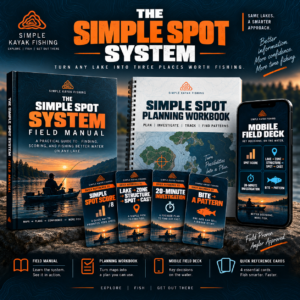
This article gives you the framework. The Simple Spot System gives you the complete method and the tools to actually use it before and during a fishing trip.
You’ll get:
- Simple Spot System Field Manual
- Simple Spot Planning Workbook
- Mobile Field Deck
- Quick Reference Cards
- The complete /8 Simple Spot Score
- Core structure guides
- The 20-Minute Investigation
- The Bite → Pattern method