
Some links in this article are affiliate links. If you make a purchase through them, we may earn a small commission at no extra cost to you. This helps support the site. Learn more.
Quick Reference Good
Conditions last updated: July 1, 2026
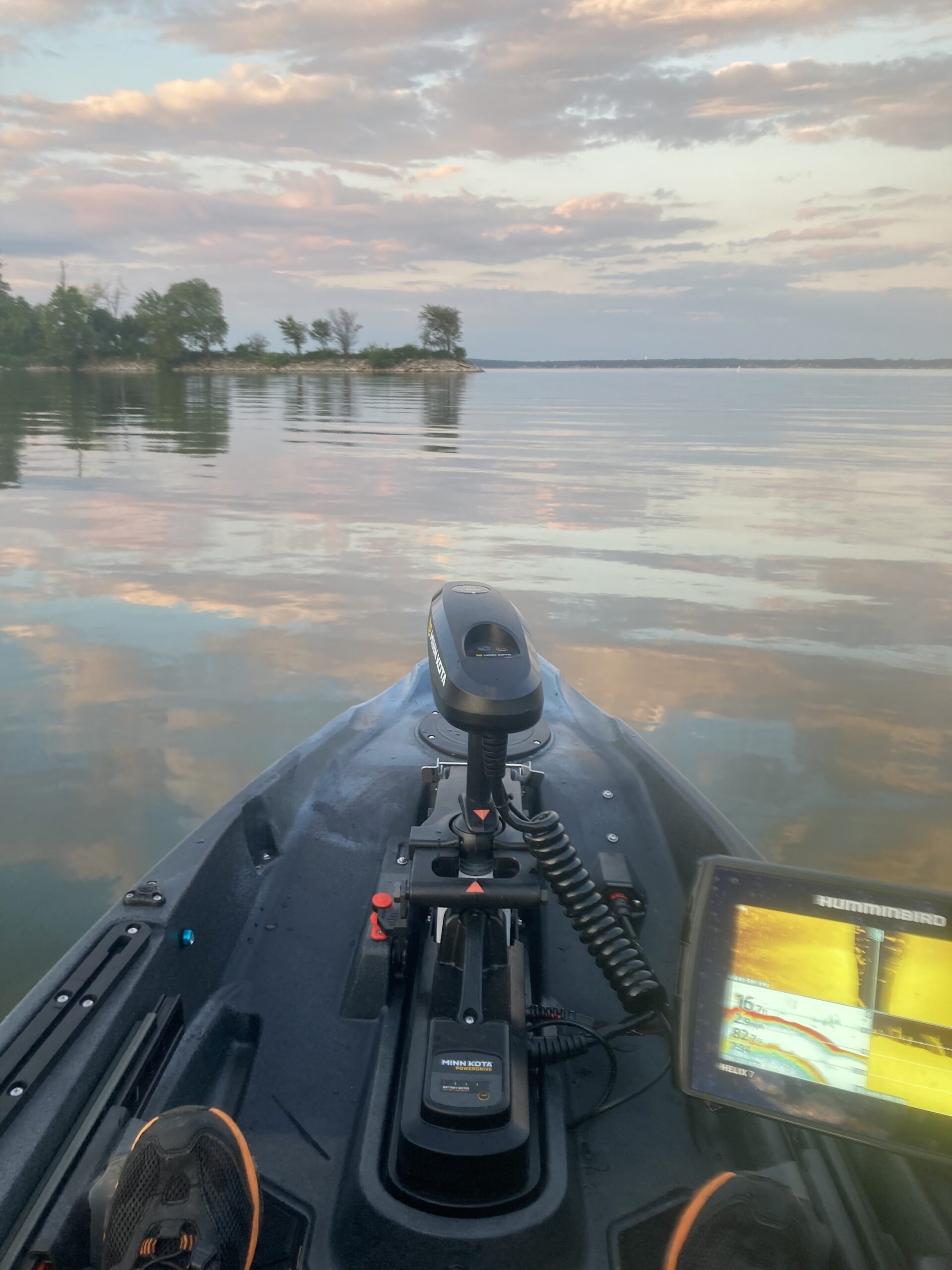
Grand Lake o’ the Cherokees is one of Oklahoma’s best fishing destinations — and it’s even better from a kayak. With 46,500 surface acres, over 1,300 miles of shoreline, and a species list that includes everything from largemouth bass to paddlefish, this lake has enough water to keep you exploring for years.
But Grand Lake is also a big, busy lake. On summer weekends, the main channels are packed with wake boats, pontoons, and tournament bass boats. That’s actually where a kayak becomes an advantage — you can slip into the shallow coves, brush-lined banks, and creek mouths that powerboats blast past. Some of the best fishing on Grand Lake is in water too skinny for anything with a trolling motor.
I keep an RV near the lake and fish Grand whenever I can. This guide covers everything I’ve learned about fishing it from a kayak — where to launch, what to target, and what gear actually matters on this water.
Species & what to throw
Grand Lake holds a genuine diversity of fish. You can catch five or six species in a single session if you’re in the right spot — I’ve pulled crappie, white bass, largemouth, catfish, and drum all from the same stretch of water near where Wolf Creek meets the Neosho River.
| Species | Best technique from a kayak | Best season | Where to find them |
|---|---|---|---|
| Largemouth Bass | Crankbaits along points, Senko (Texas-rigged) around docks and brush | March — June, September — November | Brush piles, docks, rocky points, creek channels |
| White Bass | Small jigs, Kastmasters, inline spinners — find the schools with your fish finder | March — May (spawning run), year-round | Creek channels, points, open water schooling — 15 to 35 ft deep |
| Crappie (Black & White) | Jigs and minnows, slow presentations around structure | March — May (spring spawn), October — November | Brush structure, docks, standing timber, shorelines |
| Blue Catfish | Cut bait and shad on the bottom, drift fishing from the kayak | Year-round, best March — October | Main lake, river channel, below the dam |
| Channel Catfish | Chicken liver, worms, dough bait — anchor up and let them come to you | Year-round | Creek channels, flats, docks |
| Striped Bass Hybrids | Live shad, Alabama rigs, crankbaits — hard-fighting fish, be ready | March — June, October — November | Open water, creek channels, below the dam |
| Freshwater Drum | Worms, crawfish, small jigs on the bottom | Year-round | Rocky bottoms, river mouths, flats |
A note on paddlefish: Grand Lake has the largest population of paddlefish in the world, and the snagging season (winter and spring) draws anglers from across the country. However, paddlefish snagging requires heavy gear and big water — it’s a boat game, not a kayak game. Worth knowing about, but not something you’d target from a kayak.
Best launch points for kayaks
Grand Lake has over a dozen public boat ramps, and most of them work for kayaks. That said, some are significantly better than others for a kayak angler — you want low-traffic ramps where you can load and unload without a line of bass boats behind you, and ideally close to productive fishing water so you’re not paddling a mile before you wet a line.
Wolf Creek Park
Easy launchThe premier launch facility on Grand Lake — widely considered the best tournament launch in the country. Multiple concrete ramps with huge paved parking. For kayakers, the ramp is easy but this is a high-traffic area, especially during tournament weekends. Launch early or use the edges of the ramp area. The upside: you’re right near Wolf Creek and the Neosho River confluence, which is outstanding fishing water.
Honey Creek State Park Ramp
Easy launchOne-lane concrete ramp with a dock, off State Park Road near Grove. Lower traffic than Wolf Creek, with good access to the east side of the lake. Gravel parking area. The Honey Creek arm itself has good crappie and bass fishing in the brush and timber.
Bernice State Park Ramp
Easy launchMid-lake on the west side. One-lane concrete ramp with paved parking. Less boat traffic than the southern ramps, with good access to the mid-lake points and coves. A solid option if you want to avoid the crowd.
Disney State Park (Little Blue)
Easy launchLocated in Disney on the west side of the lake. Quieter ramp with access to some of the best bass coves on the lake. The Disney area has protected coves that are ideal for kayak fishing — less wind exposure, less boat traffic.
Cherokee State Park Ramp
ModerateThree-lane concrete ramp in the southwest corner of the lake, below Pensacola Dam. Paved parking. This is a busy ramp, but the fishing below the dam can be exceptional — white bass, hybrids, and catfish stack up in the tailwater area. Be aware of current from dam releases if you’re in a kayak.
Duck Creek Access
Easy launchA quieter access point on the east side. Good for getting into the Duck Creek arm, which has excellent bass fishing with less pressure than the main body. Lower traffic and a more relaxed launch experience.
Twin Bridges State Park
ModerateLocated at the confluence of the Neosho and Spring Rivers on Highway 60 near Wyandotte. This is the upper end of the lake — more river than lake, with current that changes the fishing. Great for catfish and white bass, especially during spring runs. Be mindful of current in a kayak.
My favorite spot: Sailboat Bridge
If I could only fish one spot on Grand Lake for the rest of my life, it would be near Sailboat Bridge where Wolf Creek meets the Neosho River. This confluence creates a natural funnel where current pushes baitfish into a predictable zone, and everything that eats follows — crappie, white bass, largemouth, catfish, drum. I’ve caught all five from the same stretch of water in a single outing.
From a kayak, you can work the edges of this confluence where the current meets slack water. That seam is where fish stack up. The bass boats tend to blast through here targeting specific points, but in a kayak you can sit right on the seam and work it thoroughly. An anchor trolley is almost essential here — the current will push you around otherwise.
Launch from Wolf Creek Park and head upstream. It’s a short paddle, and the fishing starts immediately.
Conditions & what to know
Wind
Grand Lake is big enough that wind is a real factor. Oklahoma wind is no joke, and 46,500 acres of open water gives it plenty of fetch.
As a general rule, if winds are above 15 mph, stick to the protected coves and creek arms rather than the main channel.
Boat traffic
This is probably the biggest challenge for kayak fishing on Grand Lake.
Summer weekends are busy —
- Wake boats
- Jet skis
- Pontoons
- Tournament fleets
Your best move is to fish early morning (before 9 AM) or late afternoon (after 5 PM) when recreational boat traffic drops. Weekdays are significantly better. And stick to the coves and creek arms where the big boats don’t go — that’s where the fish are anyway.
Water conditions
As of the Jul 26, 2026 ODWC report: water temperature 88°F, stained, normal pool (stable). Grand Lake has settled back to normal pool after running 5.5 ft above in late June — the flood-stage timber bonus has subsided and the lake is back to its typical summer pattern. At 88°F, deep summer heat has set in; early morning and late evening are the most productive windows. Largemouth bass are Fair on crankbaits and plastic baits around brush, docks, and standing timber. Blue catfish are Fair on cut bait and shad below the dam, main lake docks, and river channel. White bass are Fair on spinnerbaits and spoons below the dam and around main lake points. Stained water rewards high-contrast reaction baits — chartreuse and white crankbaits outperform natural finesse presentations right now.
Current
The upper end of Grand Lake, near the river inflows and below the dam, has noticeable current. This is actually a positive for fishing — current positions fish predictably — but you need to plan for it in a kayak. An anchor system is important, and pedal drive kayaks have an advantage here. Don’t fight the current on the main Neosho channel without a plan to get back.
Safety
Always wear your PFD on Grand Lake. The combination of boat traffic, wind, and the lake’s size means conditions can change fast. Carry a whistle attached to your PFD, keep your phone in a waterproof case, and tell someone where you’re launching and when you plan to be back. Check the weather forecast before every trip — afternoon thunderstorms are common in Oklahoma from April through September.
Recommended gear for Grand Lake
Grand Lake’s size, species diversity, and conditions call for specific gear choices. Here’s what I’d recommend based on actually fishing this water.
Anchor System: Non-negotiable in current
If you’re fishing anywhere near the river channels or the confluence areas, you need an anchor trolley system. It lets you position your kayak bow-first or stern-first into the current and hold position while you fish. I run a YakAttack anchor trolley and it’s one of the best upgrades I’ve made.
Best Kayak Anchor SystemsRod & Reel Setup
Bring at least two rods rigged and ready — one with a crankbait or spinnerbait for covering water, and one with a Senko or jig for working structure. A medium-heavy 7-foot rod covers most situations on Grand Lake. For white bass, a lighter medium rod with a small jig or inline spinner is all you need.
Regulations
Make sure you’re familiar with Grand Lake’s specific regulations before you go. A few key points:
- Fishing license: Valid Oklahoma fishing license required. Purchase online at wildlifedepartment.com or at local bait shops and Walmart.
- Black bass (largemouth, smallmouth, spotted): 6 combined per day, 14-inch minimum length. Only 1 smallmouth per day.
- Crappie: 15 combined (black and white) per day, 10-inch minimum length. This applies to Grand Lake and all tributaries upstream to the state line.
- Catfish: No minimum length. Daily limits vary by species — check current ODWC regulations.
- GRDA inspection: All boats kept or operated on Grand Lake require a free GRDA safety inspection sticker. Kayaks are technically included, though enforcement varies. It’s a free inspection, so get it done if you can.
Always check the latest ODWC fishing report before your trip for current conditions and any regulation updates.
Nearby bait & tackle
Stock up before you head to the water. These shops are close to Grand Lake and carry what you’ll need:
- Honey Creek Outdoors — 4600 US-59, Grove — (918) 801-7653
- Blue Water Bait & Tackle — 235 W Main St, Disney — (918) 435-4623
- Blue Moon Bait & Tackle — 448820 E OK-85, Ketchum — (918) 782-4009
- Benge Creek Outfitters — 291 W Broadway Ave, Langley — (918) 782-6525
- Grand Lake Sports Center — 301 S Main St, Grove — (918) 786-2300
Nearby lakes worth checking
Frequently asked questions
Shopping for your first fishing kayak? Our best fishing kayaks for beginners guide breaks down the top boats for every budget. When you’re ready to add sonar, our best kayak fish finders will help you read structure on Grand Lake like a local.
1 thought on “Kayak Fishing Grand Lake o’ the Cherokees — Complete Guide”
Comments are closed.