
Some links in this guide are affiliate links. If you buy through them, we earn a small commission at no extra cost to you. We only recommend gear we’d actually fish with.
Quick Reference Beginner Friendly
Guide last updated: May 5, 2026
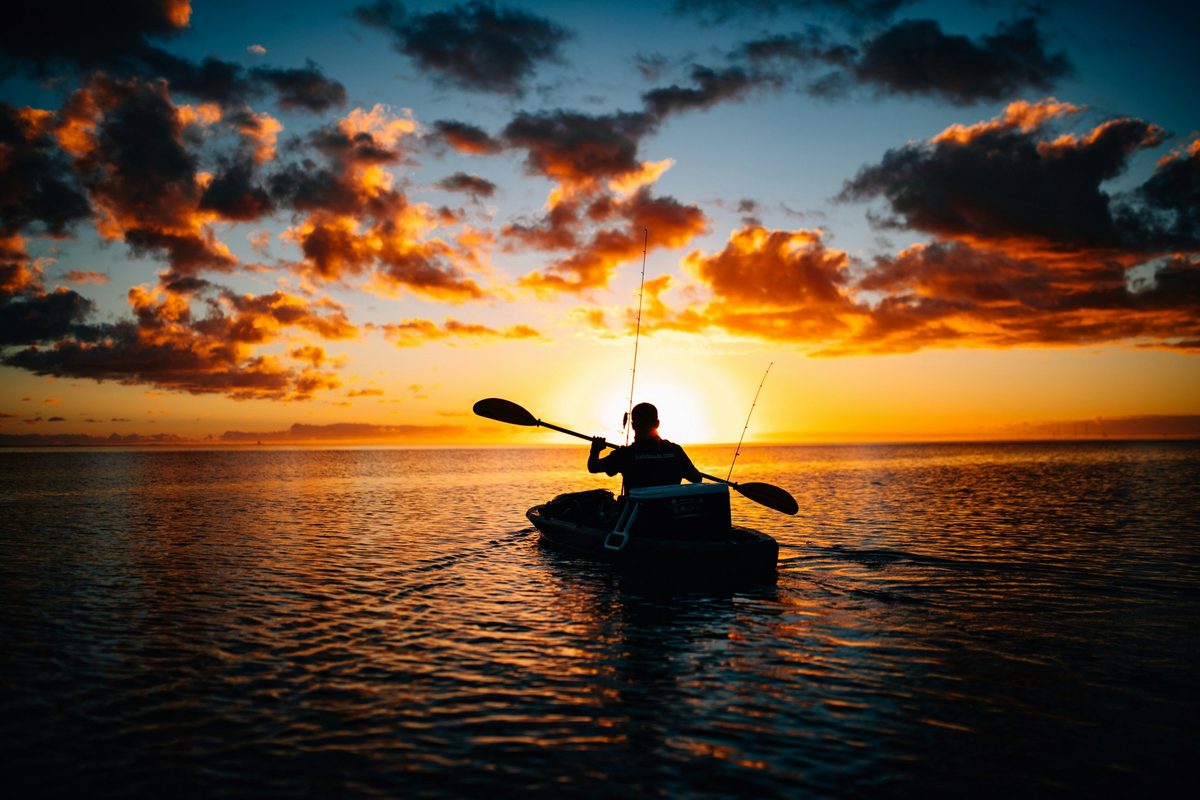
You Googled something like “I know nothing about kayak fishing — where do I even start?” Welcome. That question gets asked on r/kayakfishing every single week, and the honest answer is: it’s simpler than the gear rabbit hole makes it look. You don’t need a pedal drive. You don’t need a fish finder. You don’t need $3,000 in setup to have a great day on the water.
Kayak fishing is one of the best ways to access fish that bank anglers can’t reach and boat anglers fly right past. You can slip into shallow coves, poke into flooded timber, and sit dead-quiet over structure that a bass boat would spook. In Oklahoma, that means getting tight to the brush piles at Thunderbird, the rocky banks at Tenkiller, or a local pond where you’ve watched surface activity at dawn. All of it is achievable on your first outing — you just need to know where to start.
This guide covers everything a true beginner needs: how to pick a kayak without losing your mind, what gear actually matters on day one, how to fish from a seated position, how to handle wind and anchoring, and how to stay safe out there alone. We pulled from thousands of real posts on r/kayakfishing to answer what beginners actually struggle with — not just what fishing writers assume you need to know.
Choosing your first kayak without losing your mind
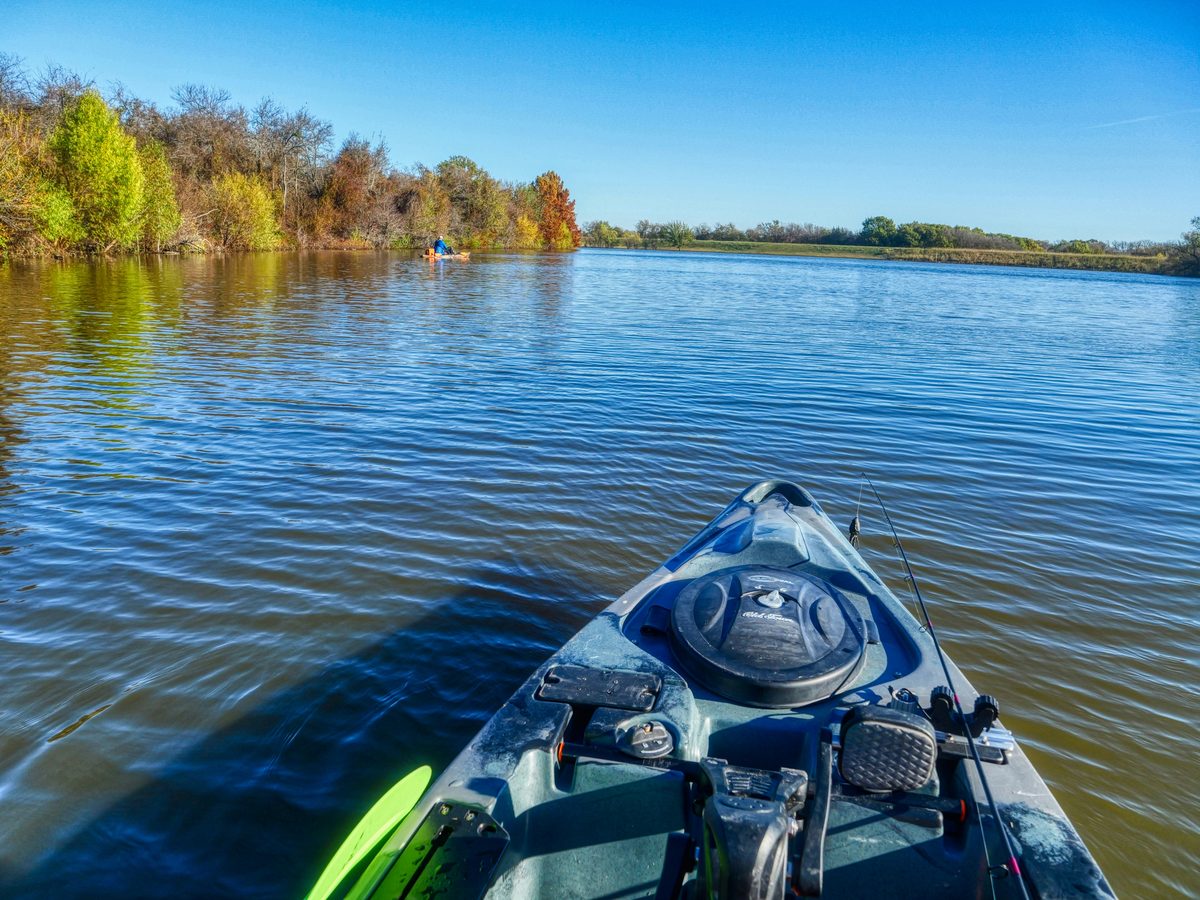
The number one question on every beginner forum, every week, is some version of “which kayak should I buy?” The short answer: a stable, sit-on-top kayak at least 10 feet long and 32 inches wide, in whatever budget you can comfortably spend. Here’s what that looks like at three price points.
Under $500 — The Walmart Find or Facebook Marketplace Yak
Budget EntryThe Lifetime Tamarack Angler 100 (regularly $199–$299 at Walmart) and its cousins are genuinely decent first kayaks. Are they as refined as a $1,200 Old Town? No. Will they get you on the water and help you figure out if you love this sport? Absolutely yes. Facebook Marketplace is the other move — look for used 10–12 ft fishing kayaks in the $200–$400 range. You can regularly find an $800 kayak for $350 from someone who bought it once and left it in the garage. Don’t let gear snobbery talk you out of a Walmart yak as your entry point. Plenty of Oklahoma anglers have caught PB bass from a Tamarack.
$500–$900 — The Smart First Kayak
Best ValueThis is the sweet spot. The Perception Outlaw 11.5, Pelican Catch Classic Angler, and Heritage Angler 12 put you in a purpose-built fishing platform with rod holders, a tank well, and a stable hull. At the top of this range, the Old Town Sportsman 106 ($899) is the benchmark mid-range kayak — consistently praised for stability, build quality, and a seat you can actually fish from for six hours. You’ll buy a kayak here you won’t need to replace until you’ve seriously outgrown it.
$900–$1,200 — The Kayak You Won’t Outgrow
Step UpThe Old Town Topwater 110, Topwater 120, and Old Town Sportsman BigWater 132 sit in this range and represent the ceiling of what a beginner realistically needs. Better seat, better stability, more rigging rail options. The Vibe Shearwater 125 is another strong pick here for comfort on longer outings. You don’t need to start here — but if you know yourself and you’ll be on the water every weekend, buying up once beats buying twice.
Pedal Drive — Should You Start There?
Nice to Have LaterPedal kayaks are the most-debated topic in kayak fishing. Hands-free propulsion is genuinely useful — you can fish and move at the same time. But pedal kayaks start at $1,300–$1,500, add mechanical complexity, and weigh more. The honest take from the community: buy a good paddle kayak first, fish it for a season, and upgrade to pedal drive if and when you actually feel the need. Most people who jumped straight to pedal drive wish they’d gotten more paddling reps first.
Best species to target as a beginner
Start with species that are forgiving — fish that bite readily, fight without tipping your yak, and don’t require precise technique to catch. Here’s where to focus your first few outings on Oklahoma water.
| Species | Why great for beginners | Best technique from a kayak | Where to find them in Oklahoma |
|---|---|---|---|
| Bluegill | Bites constantly, easy to hook, fights hard for its size — excellent confidence builder on any first outing | Small hook with a worm or cricket under a slip bobber; cast near structure and let it sit | Docks, brush piles, and weed edges on any Oklahoma lake or pond — they’re everywhere |
| Crappie | Schools up in predictable structure; the bite is consistent in spring and fall and they stack in spots you can return to | 1/16 oz jig head with a small grub or minnow, vertical jigging near brush and flooded timber | Flooded timber and brush piles at Thunderbird, Tenkiller, and Eufaula; bridge pilings in spring |
| Largemouth Bass | The most-chased species in kayak fishing — widely distributed across Oklahoma and extremely catchable on simple rigs | Texas-rigged plastic worm or crankbait along rocky banks and vegetation edges; early morning topwater | Every Oklahoma reservoir; shallow coves at dawn and dusk are most productive from a kayak |
| Channel Catfish | Very willing biters, no precise technique required — bait fishing from an anchored kayak is deadly and peaceful | Stinkbait or cutbait on a slip sinker rig, anchor in current breaks or near lake points and wait them out | Lake Hefner, Draper, and Arcadia near OKC; central Oklahoma catfish fishing is outstanding year-round |
A word on big catfish: channel cats are perfect from a kayak. Blue cats and flatheads running 30–40+ lbs are a different conversation — they will drag an anchored kayak. Get comfortable in your yak before targeting trophy-sized fish.
Essential gear — what you actually need on day one
The biggest beginner mistake isn’t buying the wrong kayak — it’s buying everything at once and arriving overwhelmed. Here’s what matters day one versus what can wait until you’ve got a few trips under your belt.
| Gear | Why it matters | Budget | Day One? |
|---|---|---|---|
| PFD (Life Jacket) | Oklahoma law requires one on board. Get a low-profile fishing PFD — much more wearable than a bulky boating vest; you’ll actually keep it on | $40–$100 | ✓ Required |
| Paddle | Most entry kayaks include one, but a quality feathered paddle matched to your kayak width makes a real difference. 230 cm works for most fishing kayaks | $60–$150 | ✓ Required |
| Rod & Reel Combo | One or two medium-action spinning combos in the 6’6″–7′ range handle bass, crappie, and catfish without switching rigs. Don’t overbuy rods on day one | $40–$120 | ✓ Required |
| Anchor System | A 1.5 lb folding grapnel anchor with 50 ft of rope and a basic anchor trolley lets you hold position without fighting the wind all day | $30–$80 | ✓ Day 1 |
| Dry Bag | Your phone, keys, and wallet need waterproof storage. A 10L roll-top dry bag is cheap insurance against the day you tip (and that day will come) | $15–$40 | ✓ Day 1 |
| Fish Finder | Helpful but not essential for beginners. Learn to read water visually first — fish structure, watch bird activity, read the banks | $150–$500 | Later |
| Trolling Motor | Great addition once you know the water, but adds weight, complexity, and battery management that beginners don’t need yet | $200–$600 | Later |
Basic techniques: how to actually fish from a kayak
The most common beginner frustration, in the community’s own words: “It was way more difficult to fish AND steer this thing than I could have imagined.” That’s normal. It takes a trip or two to stop fighting the kayak and start working with it. Here’s what helps.
Casting from a seated position
You’ll naturally want to lean into your casts — resist this. Keep your weight centered and let the rod do the work. Short, controlled casts beat heroic long-range attempts that rock the yak and miss the mark. A 6’6″–7′ rod is your best friend here; anything longer becomes awkward in a seated position and can catch the water on your backcast.
Fighting and landing fish
Keep the rod tip up and let the drag do the work. When it’s time to land, bring the fish to the kayak rather than leaning forward to meet it. For anything worth keeping, lip it or use a net placed flat on the water beside the kayak. Never lean over the gunwale to grab a fish — that’s the number one way kayaks tip.
Three rigs worth learning first
Slip bobber + worm or cricket — Set the depth, cast, let it drift. You don’t need to manage the rig constantly, which lets you manage the kayak. Great for crappie and bluegill near structure.
Texas-rigged plastic worm — Cast toward structure, let it sink, drag it back slowly. Weedless so you won’t get snagged every cast. Bass can’t resist it, and it works from a completely stationary position.
Slip sinker rig with cutbait or stinkbait — Cast, let it sink, set it in a rod holder, and wait. Channel catfish are not picky. This is how you get a personal best catfish while watching the sunrise, hands mostly free.
Understanding on-water conditions
Wind — the thing no one warns you about
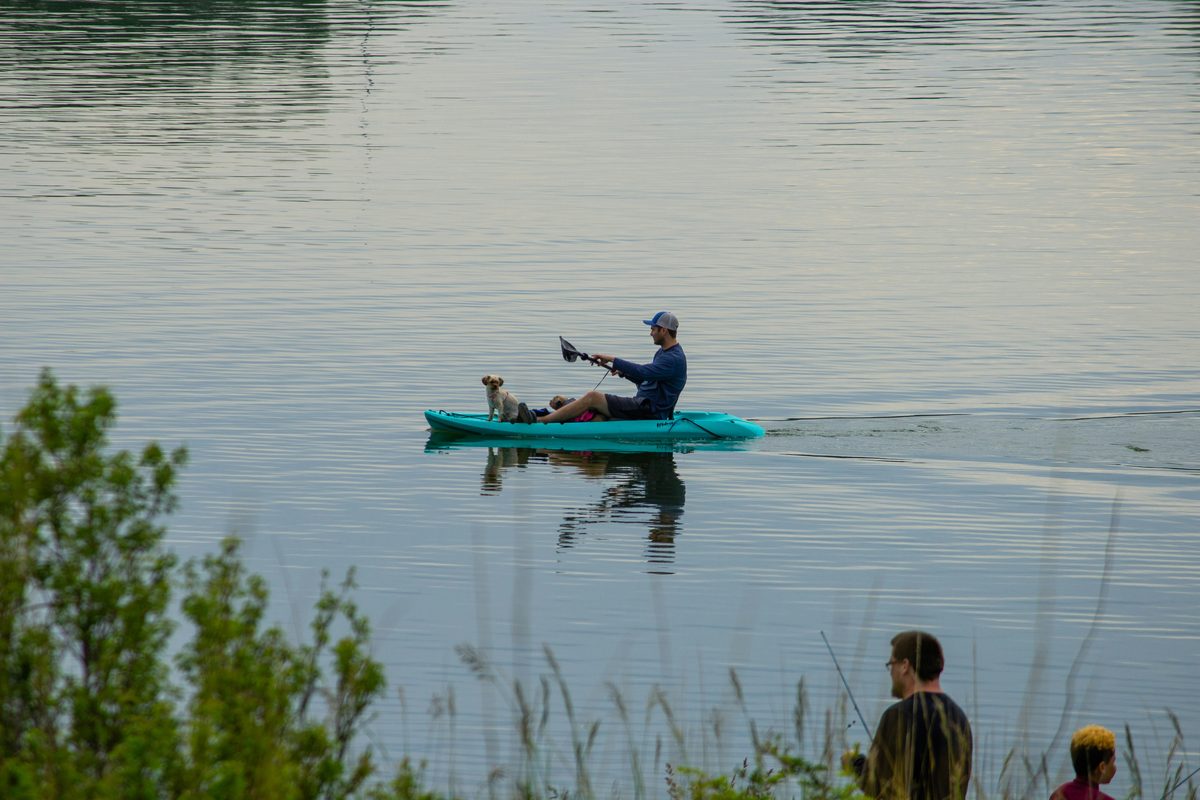
Wind is the hardest part of kayak fishing for beginners. At 10–15 mph you’ll spend more energy repositioning than fishing. At 20+ mph, seriously consider staying home. The move: always launch into the wind so you can drift back to the ramp at the end of the day. Use wind at your back to cover water by drift fishing, casting ahead of your drift. Calm mornings — 6 to 9 AM — are when beginners have the most fun and catch the most fish. Oklahoma summers heat up fast; getting on the water early isn’t just a fishing tip, it’s a sanity tip.
Anchoring — “the internet made this look easier than it is”
That’s a direct quote from r/kayakfishing, and it’s accurate. A kayak anchor trolley — a pulley system that runs down the side of your yak — lets you position the anchor from any point on the kayak: bow, stern, or broadside. This keeps you pointed into current or wind without constant re-paddling. Use 7 feet of rope for every 1 foot of water depth (the 7:1 scope rule). Always rig a quick-release so you can drop the line in an emergency. A $37 YakAttack anchor trolley kit is the community standard — cheap, clean, and it works.
Boat traffic
On busy Oklahoma lakes, wake from motorboats is genuinely uncomfortable in a kayak. Paddle perpendicular to oncoming wakes to take them bow-first — never get caught broadside. Stick to coves, backwaters, and protected shorelines where traffic is minimal. Early morning before 8 AM is when kayakers own the water.
Water conditions
Clear water means fish can see your bait better — but also see you. In clear conditions, anchor further from structure and use natural, subtle colors. Stained or murky water calls for brighter lures, more noise, and shallower fish. For beginners, muddy post-rain conditions are the toughest to read; start on clear or lightly stained water when you’re learning.
Sun and heat — Oklahoma’s overlooked hazard
There’s nowhere to hide from the sun in a sit-on-top kayak, and every inch of your body is exposed all day. Oklahoma summers on open water are brutal — reflected glare off the water hits you from below even when you’re wearing a hat. A long-sleeve UPF 50 sun shirt, a wide-brim hat, polarized sunglasses, and a buff or neck gaiter are not optional gear for July on Eufaula or Grand Lake. They’re survival equipment. Apply SPF 50+ to your hands and face even on overcast days. The first time you come home with your arms sunburned through a thin cotton shirt, you’ll understand.
Safety every solo beginner needs to know
Most kayak fishing accidents are preventable. These aren’t scare tactics — they’re what experienced anglers wish someone had said before their first trip.
Wear your PFD
Oklahoma law requires a Coast Guard-approved life jacket on board every kayak. Beyond the law: if you capsize in cold water or current, you have seconds to respond, not minutes. A low-profile fishing PFD like the Onyx MoveVent Dynamic is comfortable enough to wear all day — mesh back panel, rod and tackle pockets, a cut that doesn’t fight your seat back. You forget it’s on. There’s no catch worth skipping it.
Tell someone your float plan
Before every solo trip, text someone where you’re launching, which direction you’re heading, and what time to call for help if they don’t hear from you. Takes 30 seconds and has saved lives. Make it a habit from your first outing — experienced kayak anglers do this every time.
Cold water is the silent risk
Cold shock hits in the first 1–3 seconds of immersion and causes involuntary gasping. In 60°F water you can lose grip strength and cognitive function within minutes — even in Oklahoma where water temps drop on rivers in early spring. If the water is cold, dress for immersion, not the air temperature. Know the risk and plan accordingly.
Use the 120 rule as a quick gut-check: add the air temperature and the water temperature together. If the combined number is below 120°F, dress for immersion — wetsuit or drysuit — not for the air. In Oklahoma, that typically means being mindful from November through early May on most reservoirs, and year-round on spring-fed creeks and the upper Illinois River in the northeast. A sunny 65°F April day feels warm on shore; 55°F water will end a solo float fast.
Capsize recovery
Sit-on-top fishing kayaks are nearly impossible to sink — they have sealed hull compartments. If you go over: stay calm, hold onto the kayak, kick to shallow water, and right it by pulling on the far gunwale. Practice this intentionally at a calm launch before you need to do it for real. It takes 20 minutes to learn and removes the fear entirely.
Gear leashes — the trade-off worth knowing
Paddle leashes and rod leashes keep gear attached to the kayak if you tip — which sounds like a no-brainer until you read the other side of the argument on r/kayakfishing. The counterpoint: leashes can tangle around you in a capsize. The community consensus: leash your paddle (it floats away fast and drifts faster than you can swim), but keep rod leashes short and clipped in a way that releases cleanly. Skip leashing heavy gear that could drag or tangle. Know where your knife is — a safety knife on the shoulder of your PFD can cut a tangled line in seconds.
5 mistakes Oklahoma beginners make (and how to avoid them)
These aren’t edge cases — they’re the things that turn a promising first outing into a frustrating one. Every one of them shows up on r/kayakfishing every week, and every one is avoidable.
- Ignoring Oklahoma’s afternoon wind. Calm at sunrise, 20 mph by noon on Grand Lake, Eufaula, and Texoma. Check Windfinder the night before, plan your route so the wind is at your back on the way home, and stay inside protected coves when it builds.
- PFD in the hatch, not on your body. It satisfies Oklahoma law but won’t save your life from the hatch. Buy a thin, breathable vest you’ll actually wear — NRS Vapor or Stohlquist Fisherman — and it stops being a debate every trip.
- No anchor system on open water. Oklahoma wind pushes you off every productive spot you find. A 3-lb grapnel anchor and an anchor trolley cost under $40 total and transform how precisely you can fish structure. It’s the upgrade most beginners wish they’d made on trip one.
- Driving 3 hours without checking the ODWC report. The ODWC publishes weekly fishing reports for every major lake — current conditions, what’s biting, depth, technique. Check wildlifedepartment.com/fishing/fishingreport before any trip worth a long drive.
- Adding a trolling motor without registering the kayak. The moment you attach any electric trolling motor, your kayak becomes a motorized vessel under Oklahoma law and must be titled and registered with the Oklahoma Tax Commission. Operating without it on state waters is a citation offense.
Recommended starter gear
These are the pieces we’d put in any beginner’s hands from day one — solid gear at prices that don’t require a second mortgage on the house.
Starter Kayak: Old Town Topwater 110
The Old Town Topwater 110 hits the sweet spot for beginners who want a kayak they won’t outgrow in a season. It’s 33 inches wide for serious primary stability, handles a 400 lb capacity, and ships with a comfort seat you can actually fish from for six hours. The hull tracks well across Oklahoma’s flat reservoirs and handles mild chop without becoming exhausting to control. If the price feels steep, look for last year’s model or a used one — these kayaks hold up well and move fast on Facebook Marketplace.
Best Starter Fishing KayaksFishing PFD: Onyx MoveVent Dynamic
This is the PFD the kayak fishing community actually wears — not the bulky orange vest from the closet. The MoveVent Dynamic has a mesh back panel that doesn’t fight your seat back, multiple rod and tackle pockets, and a cut that stays comfortable all day. It’s the difference between a PFD you actually wear versus one you leave in the hatch. Oklahoma law requires one per person on board — this is the one worth buying right.
Best Kayak Fishing PFDsAnchor System: YakAttack Anchor Trolley Kit + Folding Anchor
The YakAttack anchor trolley is the community standard — installs cleanly, works reliably, and runs about $37. It lets you position your anchor point anywhere along the kayak rail so you stay pointed into wind or current without constantly re-paddling. Pair it with a 1.5 lb folding grapnel anchor and 50 ft of nylon rope for a complete system under $80. This single accessory will improve your fishing more than any new lure or technique — holding position is everything.
Best Kayak Anchor TrolleysBeginner Rod & Reel Combo
Start with one or two medium-action spinning combos in the 6’6″ range. The Ugly Stik GX2, Abu Garcia Veritas, and Zebco 33 spin combos are all solid choices under $80 that handle bass, crappie, and catfish without issue. Spool with 10 lb braid and you’re ready for most of Oklahoma’s freshwater species. You don’t need a dedicated bass rod, a crappie rod, and a catfish rod on your first dozen outings — one good versatile combo catches plenty of fish.
Oklahoma kayak fishing regulations
Make sure you’re legal before your first trip:
- Fishing license: Anyone 16 and older needs a valid Oklahoma fishing license. Annual resident licenses run about $25 — buy at wildlifedepartment.com/licensing, any Walmart sporting goods section, or a local bait shop.
- PFD requirement: One Coast Guard-approved life jacket must be on board for every person. Children under 13 must wear one at all times while on a kayak in Oklahoma.
- Navigation lights: If you’re on the water after sunset or before sunrise, display a white light visible 360 degrees. A clip-on LED flasher satisfies this requirement and costs less than $10.
- Bag and size limits: Each lake may have specific limits for bass, crappie, and catfish. Check the ODWC regulations at wildlifedepartment.com before fishing a new body of water for the first time.
For beginners fishing central Oklahoma lakes and ponds, the short version: get a fishing license, wear or carry a PFD, and you’re good to go on most water.
Good starter lakes in Oklahoma
Oklahoma has outstanding kayak fishing within an hour of most of the state. Here’s where to start based on where you live:
Frequently asked questions
Everything else you need for Oklahoma kayak fishing
This guide is the starting point. Here’s where to go next — every link goes deep on one specific topic beginners ask about most.